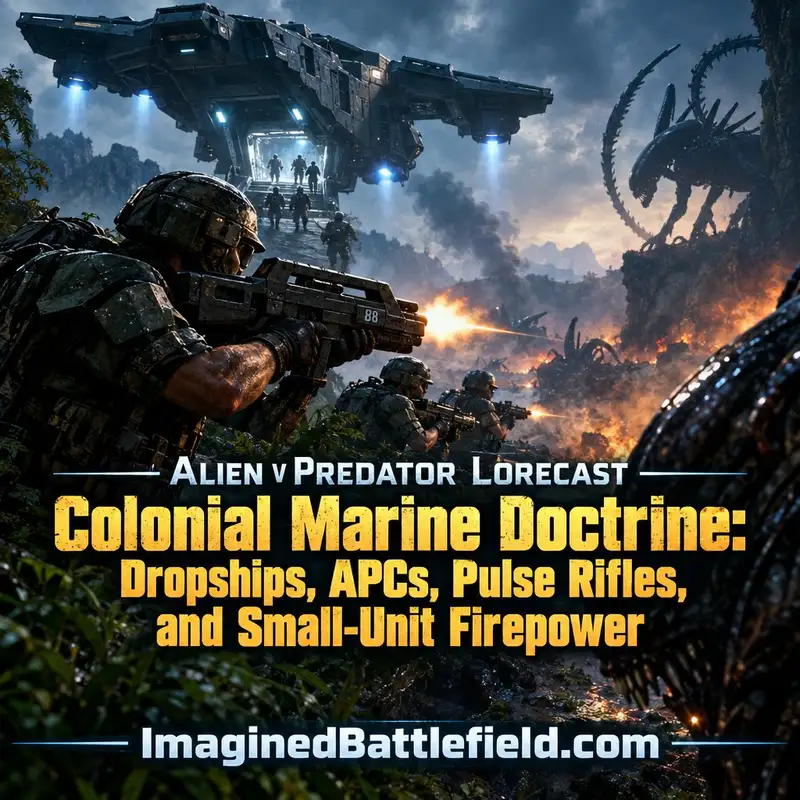
Colonial Marine Doctrine: Dropships, APCs, Pulse Rifles, and Small-Unit Firepower
Beneath the primary heat exchangers of Hadley’s Hope, the Colonial Marines reach the point where their equipment becomes a liability. Lieutenant Gorman orders them to remove the magazines from their pulse rifles and put away their grenades. The ammunition is explosive. A firefight under the colony’s atmosphere-processing machinery could damage systems that keep the settlement viable, or trigger a catastrophe far beyond the squad’s immediate position. The Marines are left with flamethrowers, sidearms, and whatever judgment they can retain in a dark, enclosed industrial space.
It is a severe contradiction. This is an expedition equipped with automatic weapons, crew-served guns, armor, motion trackers, radios, an armored personnel carrier, and a dropship capable of moving people between orbit and the surface. Yet at the decisive moment, much of that firepower cannot be used safely. The disaster that follows is not evidence that the Marines arrived unarmed. It shows that weapons are only one part of military capability. Intelligence, terrain, command, mobility, extraction, and the limits imposed by civilian infrastructure all decide whether a weapon can be fired, where it can be fired, and whether firing it makes the situation better.
Hadley’s Hope is the clearest screen example of Colonial Marine expeditionary practice in action, but it is not a complete service manual. The film does not establish one universal order of battle, squad size, or inventory for every deployment. What it does show is a compact force built around combined systems. Infantry depend on spacecraft, aviation, armored transport, sensors, communications, technical specialists, and an extraction plan. When those systems reinforce one another, the force can move fast and concentrate violence at a remote emergency. When they fail in sequence, courage and powerful weapons cannot restore the original advantage.
The mission begins as a response to silence. Hadley’s Hope has stopped communicating with the outside world. The colony on L V Four Twenty-Six is not presented as a military outpost waiting to be relieved. It is a labor community, dependent on industrial infrastructure, transport, administration, and the atmosphere processor that makes long-term settlement possible. Families live there. Workers maintain the installation. Children are part of the population. By the time the Marines arrive, most of those people have disappeared into a biological disaster that the expedition does not yet understand.
Ripley is brought in because she has survived an earlier encounter with the organism. Her knowledge is unusually valuable, but it is also incomplete. She knows what one Alien did aboard the Nostromo. She knows what it did to a crew trapped in a commercial ship. She does not know the full condition of Hadley’s Hope, the number of organisms present, whether there are survivors, or what form the outbreak has taken. The Marines receive a warning from someone with direct experience, but not a clear operational picture. They are preparing for a missing colony, not a confirmed assault against a mature nest of creatures with concealed routes, unknown numbers, and a reproductive cycle already well advanced.
Carter Burke adds another pressure to the mission. He represents Weyland-Yutani’s local corporate interest, and he has reasons to preserve the colony and to value the organism as more than a public safety threat. His conduct should not be expanded into a claim that every corporate employee, administrator, or Marine understands or shares his priorities. The film does not show a single all-knowing institution directing every decision. It shows a more familiar and more dangerous arrangement. A corporation has an interest in a colony. A civilian representative accompanies a military mission. A survivor has knowledge that formal authority initially treats with caution. And the people most at risk are the workers and families whose settlement has already vanished.
Lieutenant Gorman holds formal military command. Master Sergeant Apone provides experienced enlisted leadership close to the Marines on the ground. Hicks is one of the subordinate leaders whose calm becomes increasingly important as the mission collapses. Ripley begins as a civilian advisor. Bishop, the synthetic assigned to support the operation, is essential to the expedition’s technical and flight capability. Burke has influence but not ordinary military command. This divided structure is manageable while the operation remains routine. It becomes dangerous when the mission shifts rapidly from investigation to survival. Formal rank still exists, but practical control begins to move toward the people who can see the threat, operate the equipment, and make decisions under immediate pressure.
The deployment from the Sulaco reveals what the Marines are designed to do. The Sulaco serves as the interstellar staging platform. It carries the expedition across the distance between settled human space and a remote colony. That is strategic mobility. It is the ability to place personnel, vehicles, equipment, and supplies in a distant theater at all. But strategic mobility does not win the ground fight. Once the expedition reaches orbit, the dropship becomes the link between space and the surface. It inserts personnel, carries the armored personnel carrier, provides aerial movement, and offers a means of emergency extraction.
The dropship is not shown as a conventional fighter or bomber. It is not simply a flying gun platform, even though it can support troops under pressure. Its central value is that it allows the ground force to arrive, reposition, and leave. That last function is the most important. A unit can accept danger on the ground if it retains a credible way to withdraw casualties, recover survivors, and break contact. Once the dropship is lost, the Marines are not merely short of transportation. They lose the mechanism that turns a risky descent into a temporary mission rather than a siege.
The armored personnel carrier has a related but different purpose. It is not a tank built to destroy an enemy formation through heavy armor and overwhelming direct fire. In the Hadley’s Hope operation, it is protected mobility. It carries personnel through exposed ground and industrial approaches. It houses communications equipment. It receives helmet-camera feeds and motion-tracker information. It gives Gorman a place from which to monitor the operation. It can become an evacuation vehicle, an improvised command post, and a physical barrier between survivors and the organisms pursuing them.
The Marine weapons package is similarly integrated. Pulse rifles give individual Marines portable automatic fire. The film shows that these weapons can kill the Aliens. Their weakness is not that they lack stopping power. Their problem is that killing an organism in a confined facility may release acid blood into floors, walls, machinery, or people nearby. In an open area, automatic fire can establish distance and suppress an advancing threat. In a colony full of critical systems, every burst carries a second question. What lies behind the target, beneath it, or above it? A weapon that removes one immediate danger may create a chemical breach or an industrial failure.
Smart guns provide a different kind of firepower. They allow operators to sustain rapid, directed fire against visible targets, with stabilization and targeting assistance that help manage the weapon under stress. But they remain operator-dependent, line-of-sight tools. They require ammunition, fields of fire, and time to react. A smart gun cannot solve a threat it cannot see. It cannot protect a position from every angle in a structure full of overhead spaces, walls, machinery, ducts, and concealed access routes. Its strength is controlled volume of fire. Its limit is that volume alone does not establish control of the battlespace.
Flamethrowers become important because fire can create separation. They can deny a route, deter an approach, and give frightened people a moment of space. In close quarters, that matters. But a flamethrower is not a universal answer to the organism. It produces heat, smoke, glare, and fuel hazards. It can limit visibility as easily as it improves it. It also demands close-range discipline. A Marine using fire in an enclosed area is managing not only the enemy, but the safety of nearby personnel, the condition of the air, the possibility of secondary fires, and the risk of forcing the threat into another route rather than destroying it.
Motion trackers narrow uncertainty. They do not remove it. A contact may be behind a wall, above a ceiling, below a floor, or moving through a service space that does not appear on the operator’s immediate map. The display can show that movement is closing. It cannot reliably identify species, elevation, route, intent, or number. In a vertical industrial environment, the danger comes when warning is mistaken for understanding.
Helmet cameras and radios extend the commander’s awareness, but they do not eliminate the distance between the carrier and the people moving through the complex. Gorman can see fragments of the action. He can issue directions. He can watch tracker data and attempt to place teams. Yet a remote feed is not the same as being present on the ground. It lacks depth, peripheral awareness, smell, physical orientation, and the subtle cues that experienced people use to judge danger. The Marines’ equipment gives their commander more information than a force without sensors would possess. It does not create a perfect picture, especially when the threat moves through the colony’s hidden architecture.
Before the Marines encounter the nest, Hadley’s Hope has already begun to teach them what kind of battlefield they have entered. The colony contains signs of desperate resistance. There is evidence of an earlier firefight. There are scars where acid has burned through more than one level of the structure. The damage is important because it changes the tactical meaning of a successful shot. The organism’s blood is not merely a gruesome detail. It is a battlefield hazard. It punishes careless engagement in enclosed areas and threatens the systems that make the colony habitable.
The settlement itself is part of the conflict. Hadley’s Hope is a workplace, a residential community, a processing site, and a network of corridors, rooms, machinery, and service routes. Its industrial design gives the Marines cover, communications nodes, doors, vehicles, and barriers. It also gives the Aliens concealment, vertical access, and multiple approaches. The Marines are not confronting a conventional enemy with identifiable fighting positions, supply dumps, uniforms, or a visible command post. They are moving through a space where the enemy can use walls, ceilings, shafts, darkness, and the remains of the colony’s own infrastructure as weapons.
Newt’s survival sharpens the civilian stakes. She is not simply proof that someone is still alive. Her presence means the mission cannot be reduced to elimination of a biological threat. There may be other survivors. There may be people hidden, trapped, injured, or carrying infections that the Marines do not yet recognize. Every decision now carries two obligations that can conflict. The force must protect itself from an organism capable of turning captured people into part of a larger outbreak. It must also search for and recover civilians who did not choose to become part of a corporate, military, or biological crisis.
The initial advance shows a force attempting to manage uncertainty with dispersion and mutual support. The Marines do not move as a single, tightly packed mass. Teams cover different approaches. Personnel occupy rear and elevated security positions. Motion trackers are used to watch for movement. Information flows back toward the carrier. This is reasonable small-unit behavior for a search operation in an unfamiliar site. A compact force needs to avoid presenting one easy target, while maintaining enough communication to bring support where it is needed.
But the arrangement is fragile. Dispersion only works if the teams can still support one another. Sensors only help if they can be interpreted quickly. A command vehicle only improves control if the commander’s picture remains connected to the actual ground situation. The Aliens exploit the gap between those conditions. They do not need to overpower every Marine in a fair exchange of fire. They need to remain difficult to locate, force the unit to divide attention, and use the structure’s vertical routes to appear where the Marines are least prepared to respond.
The nest beneath the atmosphere processor changes the mission immediately. Search and rescue becomes containment under catastrophic constraints. Ripley recognizes the danger posed by explosive ammunition near the heat exchangers, so Gorman’s order to restrict weapons is not irrational. Unrestricted fire could kill organisms and still trigger a disaster capable of destroying the colony, its survivors, and the infrastructure that offers their only shelter and escape.
The difficulty is timing. The Marines reach the area carrying tools designed to establish distance through automatic fire and grenades. They are then told to surrender those advantages just as they enter a cramped space where the enemy is closest, best concealed, and already organized around ambush. The order strips away not every weapon, but the weapons in which the unit has placed the most immediate confidence. Rifles are slung. Magazines are removed. Grenades are no longer an option. The Marines retain flamethrowers, but fire is a poor substitute for controlled automatic fire when targets are appearing suddenly at close range and the formation is losing cohesion.
The ambush is not best understood as a simple failure of bravery. The Marines have been given the wrong threat model. Their reconnaissance is incomplete. Their weapons restrictions are severe but understandable. The terrain favors the enemy. Their senior enlisted leader is taken in the opening shock. Communications become confused. Visual contact collapses. Gorman, who has formal command but little practical experience with this kind of close-range disaster, struggles to convert partial information into orders that the people on the ground can use.
The loss of Apone matters because a small unit depends on more than its commissioned commander. Experienced enlisted leaders turn general intent into movement, fields of fire, accountability, and immediate decisions. When Apone is removed, the Marines lose a stabilizing presence close to the formation. Gorman remains alive, but the chain of command has already become brittle. In the confusion that follows, the organization has rank, weapons, radios, and vehicles. What it lacks is a shared picture, a viable plan, and enough time to rebuild cohesion under attack.
Ripley’s decision to drive the armored personnel carrier into the complex is one of the clearest examples of practical command replacing formal control. She is not promoted. She does not become a Marine officer. She acts because Gorman is unable to direct an effective rescue, because she understands the nature of the threat better than anyone else present, and because the carrier is the only available tool capable of reaching the trapped survivors quickly. Her action is an emergency intervention, not a normal command arrangement.
The carrier’s rescue role demonstrates its real value. It is a protected vehicle able to cross ground that exposed infantry cannot safely hold. It becomes transportation, cover, evacuation space, and an improvised battering ram against the paralysis created by the ambush. It gives the survivors a temporary barrier between themselves and the creatures. But it cannot reverse the larger failure. It cannot search every route in the hive. It cannot replace the lost Marines. It cannot restore the dropship, recover the colony, or guarantee that pursuit will end at the vehicle’s hull.
Hicks emerges as the senior surviving Marine and provides a steadier form of field leadership. His importance is not that he transforms the surviving group into an invincible force. It is that he helps preserve discipline after the original plan has failed. He understands that the priorities have changed. The mission is no longer a routine investigation with military support. It is now an effort to keep a small number of people alive, manage limited resources, and find a route off the planet before the colony’s dangers close around them.
The first dropship’s destruction is the decisive operational loss. The immediate effect is obvious: the Marines lose ready airborne evacuation and close support. The deeper loss is logistical. Casualty evacuation becomes harder, resupply disappears, and the force can no longer assume it can break contact by lifting into orbit. From that moment, every injury, weapon malfunction, damaged vehicle, and lost barrier matters more because replacement is no longer waiting overhead.
The expedition has become a stranded defensive pocket. The survivors still have weapons, but ammunition is finite. They still have the carrier, but it is damaged and cannot remain a reliable long-term refuge. They have medical supplies, welding tools, doors, rooms, and some ability to improvise defenses. They have no certainty about communications, no easy rescue, and no reason to assume that the organisms will stop pressing the attack. The atmosphere processor remains both a source of danger and a strategic constraint. The colony is still full of systems that can fail catastrophically if handled without care.
The Special Edition of Aliens adds an important but cut-specific illustration of this problem. In that version, the survivors establish a defensive perimeter with welded doors and remote sentry guns. The sequence is absent from the original theatrical release, so it should not be treated as part of that version’s on-screen account. But as an alternate released scene, it clarifies what the Marines might do once maneuver has become impossible. They create layered defenses, monitor movement, and use automated weapons to extend their fields of fire without exposing every surviving person at the doorway.
The sentry guns work for a time because static defenses can buy time. They force the approaching organisms to absorb danger at a controlled choke point. They reduce the immediate burden on exhausted defenders. They give the survivors warning that the perimeter is under pressure. Yet the sequence also shows the limits of automated firepower. Ammunition runs down. Fields of fire remain fixed. The defenders cannot know every route through the colony. The guns can delay contact, but they cannot restore lost mobility, recreate an extraction plan, or establish that the threat has been fully identified.
That is the larger lesson of the siege. Once an expedition loses the ability to move, resupply, and leave, doctrine becomes less about assault and more about time. The defenders need to slow the enemy, preserve ammunition, keep doors between themselves and the threat, protect the vulnerable, and create enough time for a new escape option. They are no longer shaping the battlefield. They are trying to prevent the battlefield from closing completely around them.
A second dropship eventually creates that escape option. Its availability changes the survivors’ position, but it does not make the return to the hive routine. Ripley goes back for Newt because the immediate objective has narrowed to a rescue. Her equipment reflects improvisation under extreme conditions. She carries a pulse rifle, a flamethrower, grenades, marking flares, and whatever she can use in the confined spaces ahead. This is not a standard demonstration of Colonial Marine squad tactics. It is an exceptional individual assault by a civilian survivor operating under emergency conditions with a single, urgent purpose.
The local success of that assault depends on clarity. Ripley is not trying to clear the entire colony, study the organism, preserve the facility, or conduct a textbook containment operation. She is trying to find one child and get out. A narrow objective can make action possible when the larger mission has become impossible. Her weapons give her options at different ranges. Fire creates space. The rifle provides immediate force. Grenades and flares support movement through the nest. But even then, the action remains dangerous because the organism’s environment, reproduction, and access routes are not under human control.
The final confrontation with the queen matters less as a contest of individual strength than as a reminder that the outbreak remains biologically dangerous until evacuation is secured. A nest is not merely an enemy position. It is a reproductive system. The more time it has to operate, the more the crisis can expand beyond the original casualties. The immediate question is not whether one person can defeat one creature. It is whether survivors, eggs, organisms, or contaminated material can leave the colony together. Extraction is therefore part of containment. Getting off the planet without carrying the threat into a ship is as important as any fight inside the hive.
Bishop’s role reinforces the same point. Survival depends on technical labor, flight operations, access to systems, and the ability to make the final transport function under pressure. Infantry weapons alone do not save the survivors. The dropship matters. The carrier matters. Doors, communications, welding equipment, airlocks, medical care, and the willingness of people to perform difficult technical tasks all matter. The Marines’ doctrine, as observed at Hadley’s Hope, is not about rifles in isolation. It is about an expeditionary network that becomes visible only after its pieces begin to fail.
The operation achieves a limited tactical success. A small number of people survive. Newt is recovered. The immediate organisms encountered by the survivors are denied an easy route off the colony. But the mission does not save Hadley’s Hope. The missing labor community is not restored. Most of the expedition is lost. The first dropship is destroyed. The carrier is damaged beyond usefulness as a continuing mobility asset. The force does not conduct a clean withdrawal from a secured site. It escapes from a collapsing disaster after losing nearly every advantage with which it arrived.
Hadley’s Hope makes the system behind Colonial Marine firepower visible. The dropship provides strategic reach and extraction. The armored personnel carrier provides protected movement and a command node. Pulse rifles and smart guns provide concentrated fire. Flamethrowers create temporary denial. Sensors provide warning. Radios connect dispersed teams. Technical personnel keep the whole network functioning. None of those tools is useless, and none is sufficient on its own.
Hadley’s Hope is therefore not simply a story about a heavily armed force defeated by a stronger monster. It is a study of an expedition losing the ability to employ its strength. The Marines bring speed, armor, sensors, automatic weapons, and courage to the colony. Industrial limits, concealment, bad intelligence, collapsing mobility, and corrupted mission priorities turn those advantages into partial tools rather than decisive ones. The survivors escape because they adapt, cooperate, and keep moving. The institution behind the mission fails because it mistakes equipment for control.