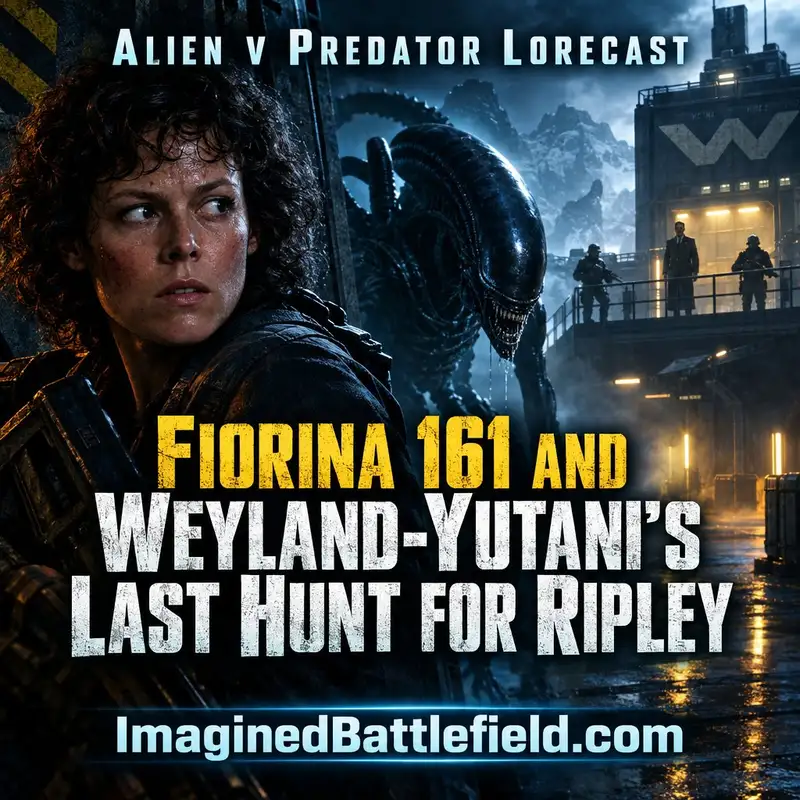
Fiorina 161 and Weyland-Yutani’s Last Hunt for Ripley
The adult Alien is already dead when Weyland-Yutani finally reaches Fiorina 161. The foundry is wrecked, most of the people who fought the creature are gone, and Ellen Ripley has survived yet another disaster. An armed corporate team arrives with medical personnel, transport, and the authority of the company that owns the prison. On paper, order has returned. In reality, the most important confrontation is only beginning, because Ripley is carrying a Queen embryo and the company has come for what is inside her.
That is the real significance of Fiorina 161. The incident begins as a local containment failure, becomes an improvised hunt through an industrial prison, and ends as a struggle over who controls a living host. Weyland-Yutani possesses ships, weapons, doctors, and legal authority. It still fails to recover the one asset it wants most. The reason is not a lack of force. The company confuses information with control, ownership with legitimacy, and possession of a biological specimen with actual containment.
The theatrical account of Alien Three is the controlling history here. Its immediate predecessor is the escape from L V Four Twenty-Six at the end of Aliens. Its consequences should not be folded into the much later cloning program of Alien Resurrection. On Fiorina 161, this is still a Weyland-Yutani recovery operation, and the company is not shown to possess complete mastery of the Alien organism. It knows enough to recognize value. That is not the same as knowing enough to manage the danger.
Ripley reaches Fiorina through failure, not design. After escaping L V Four Twenty-Six, she, Newt, Corporal Hicks, and the badly damaged synthetic Bishop enter cryonic sleep aboard the Sulaco. They have survived a colony-wide catastrophe and the destruction of a far larger Alien threat. They should be on the safest part of the journey. Instead, an emergency aboard the vessel ejects the occupied cryonic chambers in an escape vehicle, which crashes near Fiorina 161.
Ripley is the only living human survivor. Hicks and Newt are dead. Bishop has been reduced to wreckage that can provide fragments of information but no meaningful protection. The loss leaves Ripley isolated in more than a personal sense. The people who shared her knowledge of L V Four Twenty-Six are gone. She has no Marine escort, no functioning synthetic ally, no weapons, and no authority at the place where she lands. She is injured and grieving, surrounded by people whose first concern is not the wider history of Alien encounters but the disruption caused by an unexpected woman arriving in an all-male correctional facility.
She still recognizes the first question that matters. Could the danger have followed them?
Ripley fears that Newt may have carried an implanted embryo. Her insistence on an autopsy is therefore not detached curiosity. It is an attempt to determine whether the Sulaco disaster has introduced a reproductive threat into the prison. The examination finds no organism in Newt. That rules out one possibility, but it does not explain what happened aboard the escape vehicle or remove the larger danger. Ripley has enough experience to know that something may be wrong, but not enough information to say where the threat is or who is carrying it.
The film does not establish that Weyland-Yutani planted an Alien presence aboard the Sulaco, caused the crash, or arranged the deaths of Hicks and Newt. Making the corporation responsible for every step would give it more control than the story supports. What matters is what happens once a lethal organism reaches a company-controlled prison and medical information about Ripley begins moving through corporate channels. The company reacts with an urgency that ordinary survivor recovery cannot explain.
Fiorina 161 is a remote work-correctional facility built around industrial labor and foundry operations. It is not a military installation. There is no garrison, no dedicated biohazard unit, and no stockpile of specialized weapons waiting for an extraterrestrial emergency. The population is small, all male, and organized around confinement and labor. The prison was designed to keep people inside a system. It was never designed to keep an unknown predator out of the spaces where those people live and work.
That difference becomes decisive. A foundry can melt metal. A prison can enforce routine. A communications room can send messages off-world. None of those functions creates a coherent containment doctrine. The Alien can exploit darkness, machinery, shafts, blind corners, and vertical space. The people trying to stop it have walls and industrial equipment, but no reliable sensors, safe rooms, overlapping fields of fire, or tested procedure for identifying and isolating a rapidly moving organism.
Formal authority belongs to Superintendent Harold Andrews. He is responsible for discipline, order, and eventually transferring Ripley into company custody. From his perspective, she first appears to be an unwelcome complication whose warnings sound implausible. That view becomes harder to defend as evidence accumulates, but it reflects the limits of his institution. Andrews is a prison superintendent. He has authority over the facility without possessing the knowledge needed to understand what has entered it.
Jonathan Clemens holds medical authority. He treats Ripley and helps establish the circumstances of the crash. Francis Aaron, called Eighty-Five, occupies the practical space between administration, communications, maintenance, and survival. The prisoners possess another kind of expertise entirely. They know the physical plant. They understand the foundry, its passages, its heat, its machinery, and the routes through which people must move.
None of them begins with a reliable threat model. They do not know the creature's life cycle, where it came from, or what it can do. There are no motion trackers, armored personnel carriers, flamethrowers, or dropships. Information arrives through disappearances, mutilated bodies, frightened testimony, and Ripley's memories. Each early death is therefore more than a casualty. It is evidence that the facility has misunderstood the threat, assumed the wrong space was safe, or failed to appreciate how easily the creature can move through the prison's industrial geometry.
In the theatrical version, the organism emerges through a prison dog that encounters the escape-vehicle area. One host does not justify an elaborate taxonomy. Operationally, the creature's advantage is simple: it moves through Fiorina more effectively than the people trying to contain it. It can enter spaces they cannot watch, disappear before they organize a response, and force them to fight on terrain that was designed for labor rather than defense.
Ripley understands that pattern earlier than anyone else because she has seen related organisms before. Even so, experience does not make her omniscient. She does not know exactly how the organism reached the escape vehicle, how long it was present, or what happened while the survivors slept. Her advantage is not perfect knowledge. It is the ability to ask the right questions before everyone else accepts that those questions are necessary.
The crisis changes completely when Ripley gains access to the escape vehicle's medical equipment and discovers that she is carrying a Queen embryo. Until that moment, the prison faces an immediate local threat. One adult Alien can kill people, disrupt the facility, and make evacuation dangerous. The embryo inside Ripley creates a different scale of problem. She is now both a person in need of care and a potential source of future reproduction. She can be transported. She can be taken aboard a ship. If the organism is removed and preserved, the danger can leave Fiorina even after the adult creature is dead.
The film establishes the Queen embryo but does not fully explain when implantation occurred, how the organism reached the escape vehicle, or which corporate actors knew enough to anticipate any of it. Those uncertainties do not need a larger conspiracy to become dangerous. Once Weyland-Yutani receives medical information about Ripley, she stops being merely a survivor of a failed colonial operation. She becomes a biological asset with extraordinary possible value.
That value is easy to imagine. An organism able to implant hosts, reproduce under hostile conditions, infiltrate industrial spaces, and overwhelm ordinary personnel would attract scientific, commercial, and military interest. It might be studied as a weapon, a sabotage tool, or a source of biological knowledge. But recognizing value is not the same as possessing control. The company can want the Queen without having demonstrated that it can remove, isolate, transport, study, or destroy the organism safely.
Ripley understands that gap better than the people coming to retrieve her. Her response is not to negotiate better treatment. She asks Dillon to kill her.
In operational terms, Ripley has identified herself as the most dangerous containment problem on Fiorina. In human terms, the request exposes the burden of everything she has already seen. Institutions have minimized the danger before. Corporate interests have collided with survival before. She has no reason to assume that company doctors will remove the embryo only to destroy it. The company is asking her to trust a system whose interest in the organism is precisely what frightens her.
Dillon becomes important because he can provide something the prison's formal hierarchy no longer can: cohesion. He has no military chain of command and no scientific expertise. His authority comes from the trust of the prisoners, his willingness to speak plainly about their situation, and his readiness to share the danger rather than direct others toward it.
He does not agree to kill Ripley immediately. First, the adult Alien has to be destroyed. If Ripley dies while the creature still controls the prison, the immediate crisis remains. Dillon turns despair into a mission. The men will use what they have, protect one another as far as they can, and force the creature into a space where the foundry itself can become their weapon.
By then, formal authority has collapsed in stages. Andrews cannot preserve the assumptions that once made his office meaningful. Clemens is killed before his medical judgment can become lasting operational direction. The bureaucracy still exists on paper, but practical authority has moved to the people who understand the threat, know the terrain, or can persuade others to keep acting under fear. Ripley supplies experience. Dillon supplies cohesion. The prisoners supply labor and local knowledge.
They do not become a trained combat unit simply because they have accepted a mission. They still lack weapons, rehearsals, communications, medical evacuation, and the ability to verify the creature's location before moving. Their plan resembles an improvised industrial disaster response more than a conventional assault. They are trying to drive a predator into a prepared killing space while preventing the facility itself from killing them first.
The foundry is their best available advantage. Its machinery is powerful enough to change the terms of the encounter, and the prisoners understand how that machinery works. Heat, molten lead, gates, corridors, and the mold can be turned toward a purpose none of the designers intended. Frontier survival rarely offers a perfect tool. Fiorina has no anti-Alien weapon. It has a furnace, a workforce, and people who have run out of safer choices.
The Alien still holds the tactical advantage for most of the operation. It is faster than the men can coordinate. It can break contact and reappear along routes they cannot watch. Every attempt to guide it exposes another person. The plan requires frightened men to keep moving after they understand exactly what the creature can do. The Alien does not need to win a formal battle. It only needs to create enough separation and confusion for fear to finish the work.
That is why the trap costs so much. Driving the creature toward the mold requires people to remain close to the danger, hold routes, make noise, and continue after others disappear. The prisoners are not expendable because of their criminal histories. Their deaths are the price of an emergency for which the institution was never prepared.
Dillon's final role makes that cost unmistakable. He stays where the trap requires him to be and holds the Alien in position as molten lead is poured into the mold. For a moment, the plan appears to work. Then the creature survives the lead long enough to force one more adaptation.
Ripley activates the sprinklers. The sudden change in conditions destroys the Alien. The moment is decisive, but it is not a universal field manual. Fiorina does not prove that molten metal or thermal shock is a guaranteed answer to every Alien organism. It proves that a desperate group can sometimes turn local infrastructure into an effective trap when it understands the terrain and accepts a terrible level of risk.
Tactically, the adult threat is gone. Operationally, Fiorina 161 has been devastated. Most of the people who made the hunt possible are dead. The prison's leadership is gone. The survivors have paid for local success with almost everything they had.
And then Weyland-Yutani arrives. The timing exposes the central irony of the incident. The people with the least equipment have already completed the most dangerous part of the containment operation. The armed corporate team does not enter a foundry full of an active predator. It arrives after the prisoners and Ripley have destroyed it. The visible threat is gone, leaving the hidden one inside Ripley as the final contested space.
Some form of medical or neuro-scan information has reached Weyland-Yutani, and the corporation knows enough to treat Ripley's condition as exceptional. It sends medical personnel and armed commandos, not merely a routine recovery crew. The film does not provide a complete transmission chain or enough information to reconstruct every step of the team's deployment. It does not need to. The company's behavior makes clear that Ripley now matters for reasons beyond rescue.
That knowledge should make quarantine the first concern. Instead, the arriving team offers extraction.
Weyland-Yutani's intelligence advantage now becomes its central failure. It knows that Ripley carries something valuable, but that knowledge is used to justify recovery rather than to establish a trusted destruction protocol. Ripley is not shown a hardened surgical environment she can evaluate. She is not given a verifiable chain of custody. There is no demonstrated procedure explaining how the embryo will be isolated after removal, who will control it, or what prevents the company from preserving it.
The company has weapons, transport, spacecraft, doctors, and overwhelming local force. None of those capabilities answers the question Ripley cares about most: what happens after the embryo leaves her body?
That is the difference between extraction and containment. Extraction moves a dangerous organism from one place to another. Containment prevents it from reproducing, escaping, being preserved without oversight, or becoming the basis of another experiment. Weyland-Yutani can promise the first. It cannot convincingly demonstrate the second.
Aaron feels the pressure of that uncertainty from another angle. Much of the crisis has found him trying to survive long enough to see his family again. That instinct is human. But the arrival of a powerful outside force does not automatically make survival safer. Corporate evacuation can also mean loss of local authority, seizure of evidence, or transfer into a system whose priorities remain unknown to the people who endured the disaster.
The man who speaks to Ripley intensifies that problem because he resembles Bishop, the synthetic whose loyalty Ripley learned to trust on L V Four Twenty-Six. He identifies himself as Bishop's creator. The resemblance creates an emotional pressure point. The company is not only presenting medical expertise. It is presenting a familiar face associated with someone who once earned Ripley's trust through action.
Ripley refuses to treat resemblance as proof. Bishop had demonstrated loyalty under danger. The company representative arrives after the fighting, backed by armed personnel, asking Ripley to permit surgery. He says the Queen will be removed and destroyed. The story does not give Ripley an independent record that proves whether that promise is true, false, or simply impossible for the institution to guarantee. She has to judge the offer from conduct, history, and the balance of power in front of her.
Her belief that Weyland-Yutani wants the organism for biological-weapon potential is consistent with the company's urgency and its interest in preservation. That does not require imagining a vast, perfectly managed breeding program. The more important point is almost the opposite. The company wants the organism before it has demonstrated mastery of it.
That is why the final confrontation is not decided by firepower. Weyland-Yutani can secure the facility, surround Ripley, and order others aside. But the asset it wants is inseparable from a living person who refuses to cooperate. The company's weapons would have mattered enormously during the foundry hunt. Now they cannot solve the problem without turning a proposed rescue into outright coercion.
Tactically, the corporate team dominates what remains of Fiorina. Operationally, it has not demonstrated a trustworthy plan for surgery, quarantine, transport, and long-term custody. Intellectually, it understands the embryo's value while misunderstanding Ripley's priorities. Politically, it owns the prison without possessing legitimacy among the people who have just watched that prison become a death trap.
Aaron's final act comes out of that collapse in trust. He attacks the Bishop-like representative and is killed. The moment need not be turned into a simple conversion from fear to heroism. Aaron is still frightened, angry, and trapped between the wish to survive and the realization that corporate control may not mean safety. His attack cannot overturn the company's physical advantage, but it makes clear that those left on Fiorina no longer accept the corporation's definition of the crisis as a recovery problem.
Ripley then makes the only containment decision she believes the company cannot reverse. As the Queen begins to emerge, she falls into the furnace. The act destroys her and denies Weyland-Yutani both the living host and the specimen it has come to recover. It is not simply despair. It is a deliberate denial operation by a woman who has concluded that every other available path leaves the company with a chance to possess the organism.
Her death exposes the limit of institutional power. Weyland-Yutani can own Fiorina 161. It can receive medical data, send armed specialists across interstellar distance, offer surgery, and promise destruction. What it cannot do is compel Ripley to believe that recovery means safety. It cannot prove a containment system it has not demonstrated. Most importantly, it cannot separate the biological value it sees inside her from the fact that the organism exists inside a person who can refuse the role assigned to her.
Morse remains the known human survivor of the theatrical account. The film does not establish that Weyland-Yutani kills every witness afterward, and no invented cover-up is needed to understand the result. The company has already failed at the objective that brought it there. The embryo is gone. Ripley is gone. The adult Alien is gone. Fiorina 161 remains a ruined corporate site where the people closest to the danger paid for failures made far above them.
Much later, Alien Resurrection presents a different institutional problem. Its cloning and research program belongs to the United Systems Military, not the Fiorina recovery team. That later effort does not prove Weyland-Yutani succeeded here. If anything, the distance between the incidents reinforces the harder lesson: Alien-related knowledge is fragmented, difficult to preserve, and repeatedly pursued by institutions that mistake biological possibility for reliable control.
Weyland-Yutani's last hunt for Ripley fails because its objectives cannot be reconciled. It wants secrecy, but secrecy destroys trust. It wants recovery, but recovery requires either Ripley's consent or domination of her body. It wants the embryo's value, but cannot prove that it can contain the consequences of acquiring it.
The prisoners proved that an immediate Alien threat could be destroyed on Fiorina, but only through improvisation, local knowledge, and devastating sacrifice. Ripley proves something even more difficult for the company to accept. An uncontrollable organism does not become safe because a powerful institution calls it property, and the person carrying that organism cannot be reduced to the container that delivers it.