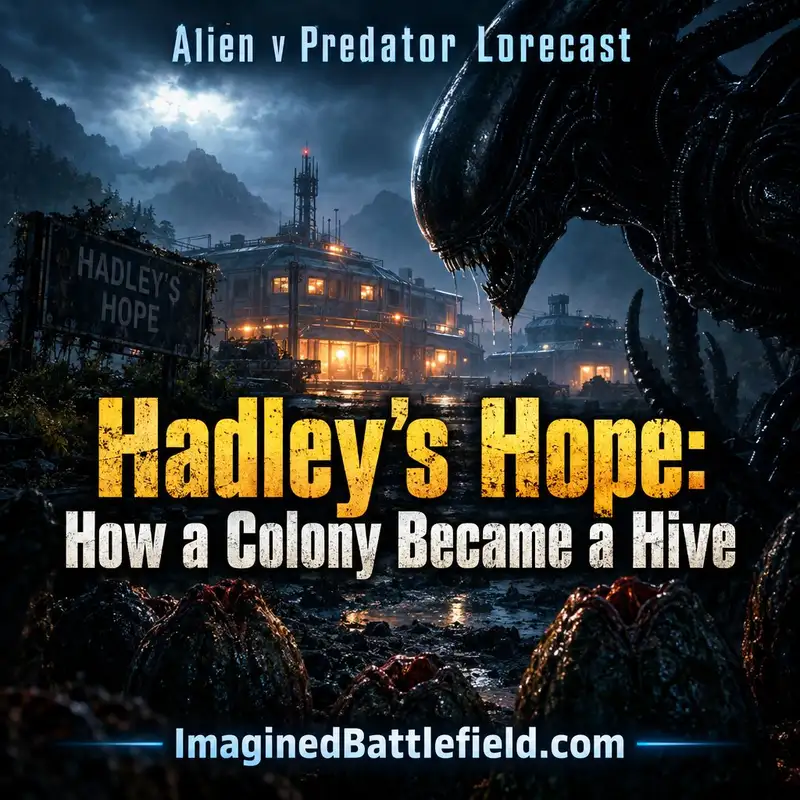
Hadley’s Hope: How a Colony Became a Hive
Beneath the atmosphere processor, the Colonial Marines find the first sign that Hadley’s Hope may still contain survivors. Their personal-data transmitters are active. The signals are clustered deep below the colony’s main industrial complex, where the ground team expects to find frightened civilians waiting for evacuation. On a rescue mission, a concentration of life signs is normally good news. It suggests people have gathered, perhaps around shelter, medical care, power, or a defensible position. Here, that assumption is fatal. The signals do not identify a refuge. They identify the place where the colony has been converted into something else.
The Marines do not yet know how many organisms are present, how long they have been loose, or whether the missing colonists can be saved. They know only that a settlement has gone silent and that some of its inhabitants are still transmitting from below its most important piece of infrastructure. They enter expecting a rescue problem. What they find is a reproductive environment built from captured human beings, industrial space, darkness, and time.
That is how Hadley’s Hope became a hive. Not in a single attack, and not because its residents lacked courage. The colony failed because it was built for routine frontier risk, industrial labor, and gradual expansion. It was not built to recognize an unknown extraterrestrial organism, isolate exposure, preserve evidence, or survive an enemy that could turn missing civilians into part of its own life cycle. By the time armed help arrived, the decisive failure had already occurred.
Hadley’s Hope was a small terraforming settlement on L V Four Twenty-Six. Later material often calls the moon Acheron, but the film’s immediate concern is more practical. This was a hard place to live, and its inhabitants were there because a long industrial project was intended to make it habitable. The colony was sometimes described as a shake-and-bake operation. That phrase sounds casual, but the work was anything but. Terraforming required heavy machinery, sustained power, maintenance crews, administrators, survey work, transport, medical facilities, communications, housing, and years of labor.
The settlement was home as well as workplace. Families lived there. Children lived there. People slept, ate, received medical treatment, attended to equipment, drove surface vehicles, filed reports, and planned for a future in which the colony would become less temporary and less dependent on outside support. The population was small, roughly one hundred and fifty people by the available evidence, though the precise figure is less important than what it means. This was not a city with redundant emergency services, multiple hospitals, and a nearby military installation. It was an isolated community where each missing technician, driver, medic, or parent represented a real loss of capacity.
Its center of gravity was the atmosphere processor. The processor was not merely a machine placed near the colony. It was the foundation of the settlement’s future. It represented air, long-term survival, industrial investment, and the possibility that L V Four Twenty-Six might eventually become a place where more people could live. It also represented danger. Any major damage to such a facility could threaten everyone nearby. That fact would later shape the Marine operation, because the people sent to investigate the colony could not simply fire every weapon they carried into its interior.
Hadley’s Hope had corridors, service ducts, operations rooms, living quarters, sublevels, machinery spaces, and routes intended for maintenance and movement. In ordinary conditions, that infrastructure made the settlement viable. It allowed workers to keep a vast industrial system functioning in an inhospitable environment. In an outbreak, the same infrastructure created concealment, alternate routes, vertical access, and dead ground. A colony designed to keep human beings alive became difficult for human beings to observe and defend.
Remoteness was part of the economic logic. Terraforming projects do not begin in convenient places. They begin where corporations, colonial authorities, and investors believe the long-term value justifies the cost and risk. The screenplay’s account describes a relationship in which Weyland-Yutani had helped finance the colony alongside the Colonial Administration, with mineral rights among the interests at stake. That does not mean every corporate employee, colonial official, or local administrator shared the same knowledge or motive. It does mean Hadley’s Hope existed inside a system where industrial expansion, territorial development, and commercial rights were closely connected.
That system had power, but it did not have perfect awareness. A company can own the transport, housing, equipment, contracts, and data channels around a colony without understanding what is happening inside every room. A colonial administration can have formal authority without possessing timely information from a distant moon. Distance still matters in a future with interstellar travel. Messages must be sent, received, interpreted, and acted upon. Rescue assets must be assigned. Decisions pass through people, offices, budgets, legal responsibilities, and competing interests.
The first major intelligence failure began before Hadley’s Hope lost contact. Ellen Ripley had survived the Nostromo incident and reported an organism encountered on L V Four Twenty-Six. Her account was not accepted as a reliable warning. The officials who questioned her believed that people had already lived on the moon for decades without reporting such a threat. From their perspective, the absence of prior incidents looked like evidence of safety. It was not. It was evidence only that no one had previously reported the danger in a way the institution accepted.
This is a common failure in frontier administration. An absence of reports can mean that a hazard does not exist. It can also mean that no one has looked in the right place, survived the encounter, recognized what they saw, or reached an authority willing to believe them. Hadley’s Hope was not judged safe because the threat had been disproven. It was judged safe because the existing system had no usable record of it.
That distinction became decisive when Ripley identified the location of the derelict spacecraft. In the theatrical version of Aliens, the essential fact is clear. Colonists were sent out to investigate the site after her account made its location available. The Special Edition adds a more detailed prologue, showing the Jorden family traveling toward the derelict and becoming directly involved in the initial discovery. That sequence provides a specific image of the first exposure, but it belongs to the Special Edition rather than the theatrical account.
The broader institutional failure is visible in either version. Civilians approached an unknown extraterrestrial site without an established quarantine perimeter, remote reconnaissance, specialized biological containment equipment, or informed understanding of the risk. They were surveyors and colonists, not a dedicated hazard-response team. They were sent into an environment where the first question should have been whether anything living, infectious, or hostile remained aboard the derelict. Instead, the encounter appears to have been treated as a survey problem.
It is tempting to describe this as a deliberate corporate sacrifice, but the evidence does not support that certainty. Weyland-Yutani had reasons to take Ripley’s report seriously. An alien vessel and possible extraterrestrial life could hold immense scientific, commercial, or military value. Yet the film does not establish a complete authorization chain, nor does it prove that every official involved knew what the colonists would find. What it shows is more familiar and, in some ways, more dangerous. A powerful institution acted on incomplete information while keeping knowledge compartmentalized. The people exposed to the risk were not given the information needed to judge it for themselves.
Once exposure occurred, Hadley’s Hope had few tools suited to the problem. A terraforming colony can handle injuries, mechanical breakdowns, harsh weather, equipment failures, and routine emergencies. It may have a clinic, emergency procedures, communications, vehicles, and secure doors. None of that amounts to a true biological containment system. Containment requires identification, isolation, controlled access, medical screening, reliable observation, secure waste handling, and authority to prevent people from carrying the hazard into the wider community. It also requires someone to recognize that containment is necessary.
The colony had no reason to begin with that understanding. The organism did not announce itself as a military force. It did not occupy the operations room, issue demands, or attack openly in a way that made its nature obvious. Its danger came from hidden infection, capture, incubation, and reproduction. A single exposure could become a second organism. A captured colonist was not merely a casualty. That person could become part of the threat’s reproductive process.
The film does not establish the exact duration of the outbreak. It does not tell us precisely how many colonists were infected, how many were killed during the initial collapse, how many were cocooned, or how many adult organisms moved through the facility. The images do not permit a reliable count. What they do establish is a progressive catastrophe. Hadley’s Hope did not simply vanish in one instant. People had time to become frightened, to hide, to move through familiar spaces, to lose contact with one another, and to abandon ordinary life.
Newt’s survival is critical evidence. She is not merely the last child found in an abandoned settlement. She is a witness to the way the colony’s geography changed under pressure. She survives by using ducts, hiding places, and local routes that adults either could not reach, could not secure, or no longer recognized as safe. Her knowledge has military value because she understands the colony as it has become, not as it was designed to function. She knows where movement is possible, where danger may come from, and how little the normal layout of a home or workplace matters once the outbreak has taken hold.
That does not mean Newt possesses a complete map of the hive or understands the organisms in scientific terms. She is a child surviving a disaster. But her existence proves that the disaster had phases. There was a period in which residents were hunted or captured rather than instantly destroyed. There was a period in which people disappeared from rooms that had once been homes, clinics, and workspaces. There was a period in which a child could learn that vents and service passages were safer than the spaces built for human life.
This is the difference between an ordinary violent attack and a Xenomorph outbreak. An armed raider, a hostile force, or a dangerous animal may kill, displace, or terrorize a population. The Xenomorph threat changes the meaning of disappearance. A missing person may be hiding. A missing person may be dead. Or a missing person may be alive in a condition that serves the organism’s reproduction. That uncertainty delays decisions, distorts rescue priorities, and makes every search party vulnerable.
The colony was not simply attacked. It was repurposed. Its population supplied hosts. Its enclosed spaces provided concealment. Its maintenance routes enabled movement. Its power kept portions of the complex active. Its industrial depth placed vital areas below ground and behind machinery. Its need for air, access, and repair gave the organisms routes that human defenders could not easily close without damaging the systems needed for their own survival.
The Xenomorphs appear to exploit walls, ceilings, shafts, smoke, darkness, and machinery spaces. They move through a human-built environment without respecting the human distinction between floor and wall, workplace and shelter, safe corridor and dead end. That observed behavior demonstrates ambush skill, adaptation, and coordinated movement. It does not prove telepathy or a universal hive mind. The film does not provide a complete theory of how the organisms communicate or organize themselves. What it shows is enough. In close industrial terrain, they can use concealment better than the people who built the facility.
The atmosphere processor becomes the clearest expression of that inversion. For the colonists, it is the core of a long-term effort to make the moon livable. For the organisms, its protected interior and surrounding spaces become a place where human movement is constrained, weapons are restricted, and captured people can be concealed. The processor is neither an incidental backdrop nor merely a large target. It is a life-support system, an industrial investment, a hazard, and eventually the physical heart of the hive.
That is why the Marines arrive too late to prevent the colony’s transformation. They are sent only after communications have failed. Their mission is formally an investigation and rescue operation. They know a colony is silent. They know Ripley has survived an earlier encounter with an organism she considers extraordinarily dangerous. But they do not possess a reliable estimate of organism numbers, reproductive status, location, access routes, or civilian survival. They have partial intelligence, which can be more dangerous than none at all because it creates confidence without understanding.
The team enters a settlement that is powered but empty. The lights still work. The systems have not all failed. The physical shell of Hadley’s Hope remains recognizable as a human place. Yet personal items have been left behind. Rooms show signs of panic and improvised defense. The absence of bodies is not reassuring. It is evidence that the missing population has not simply fled through an available evacuation route. Something has removed them from the spaces where they lived.
The Marines can read the colony’s surface signs, but they do not yet understand the process that created them. They see a community interrupted. Newt reveals that it is worse than that. The colony’s normal patterns have collapsed so completely that survival depends on avoiding the very systems that once sustained daily life. A child knows more about safe movement through the complex than the armed rescue force because she has lived through the transformation of the settlement.
Then the personal-data transmitters lead the Marines below the processor. The signals appear to resolve the uncertainty. Here are the missing colonists. Here is the location of the survivors. But the apparent concentration of life is a trap of interpretation. The people are not gathered for rescue. They are immobilized in a chamber transformed by resin, eggs, biological material, and adult organisms moving beyond the team’s immediate view.
The scene marks the exact point at which Hadley’s Hope becomes something other than a colony. The original purpose of the facility was habitation and terraforming. Its human population was meant to operate machinery, raise families, maintain systems, and extend a settlement into an environment that could not naturally support them. In the processor chamber, human beings have been reduced to hosts. The room’s function has changed from industrial support to reproduction.
The Marines find cocooned colonists. They find eggs. They encounter facehuggers. The adult organisms are present in and around the chamber, using the built environment as cover. The film does not establish a complete inventory. It would be false precision to count every egg visible in a shot, every body on a wall, or every movement on a tracker and then announce the exact size of the hive. The important fact is structural rather than numerical. The organisms have established a reproductive cycle inside the colony.
That changes the mission immediately. A rescue force can evacuate civilians from an attack. It cannot simply evacuate people who have already become hosts without first understanding the medical condition, infection status, and immediate danger around them. The personnel beneath the processor are alive, but life alone is no longer a sufficient measure of recoverability. The organism has turned compassion into a tactical vulnerability. Any attempt to reach the cocooned colonists brings rescuers close to eggs, facehuggers, and concealed adults.
Later in the theatrical film, Ripley encounters the Queen in the hive’s egg chamber. That establishes the Queen as the reproductive center of this particular colony of organisms. It does not establish that every Xenomorph outbreak in every setting develops the same way, or that every hive requires an identical queen structure. At Hadley’s Hope, however, the Queen makes the operational problem unmistakable. The colony is no longer dealing with isolated predators. It contains a functioning reproductive center capable of sustaining and expanding the threat so long as hosts and protected space remain available.
The Marines’ first contact with that mature system is violent, but the battle belongs to a later part of the story. For the colony itself, the important fact is already settled before the first Marine is lost. Hadley’s Hope is no longer a settlement suffering attacks around its edges. Its missing residents have been pulled into a reproductive process embedded inside the same infrastructure built to sustain them. From that moment, every rescue attempt has to answer two questions at once: who can still be saved, and what danger might be carried out with them?
Once the Marines understand what lies beneath the processor, the original rescue mission is effectively gone. The remaining objective becomes harsher: protect whoever is still alive, prevent the organisms from using more people as hosts, and find a way off the moon without carrying the outbreak somewhere else.
Ripley’s decision to return for Newt makes the civilian meaning of the disaster impossible to ignore. Newt is not an asset, an intelligence source, or a symbol of resilience detached from her circumstances. She is a child whose family and community have been consumed by a failure she did not cause. The return to the processor is not tactically tidy. It is dangerous because the hive has grown around the same infrastructure that keeps the colony alive. But leaving her behind would mean accepting the final logic of the outbreak, that the settlement’s people have become expendable once their utility has ended.
The atmosphere processor becomes unstable as the final escape unfolds. Destruction of the facility denies the hive its immediate environment. It also destroys Hadley’s Hope. There is no clean separation between the biological threat and the colony by this point. The hive has become embedded in the settlement’s protected interior, while the settlement’s infrastructure has become too dangerous to preserve under the circumstances. The destruction is a containment success only in the narrowest sense. It ends the immediate hive on L V Four Twenty-Six, but it does so by consuming the place the colonists spent years building.
Hadley’s Hope represented far more than corporate equipment. It was labor, family life, colonial investment, years of maintenance, and the hope that an inhospitable moon could become a permanent home. Those things vanish together when the processor is destroyed. The human loss cannot be reduced to asset value or liability. A frontier community is erased after its residents are sent toward a danger they do not understand and then left inside an outbreak no ordinary settlement was built to contain.
Hadley’s Hope did not become a hive because its residents failed to fight hard enough. It became a hive because recognition and containment failed before the colony understood what had entered it. Isolation slowed correction. The settlement’s architecture created concealment. Its people became hosts. The atmosphere processor became protected reproductive ground. By the time the personal-data transmitters led rescuers beneath the complex, the transformation was already complete. The colony had stopped functioning as a human community long before anyone arrived to save it.