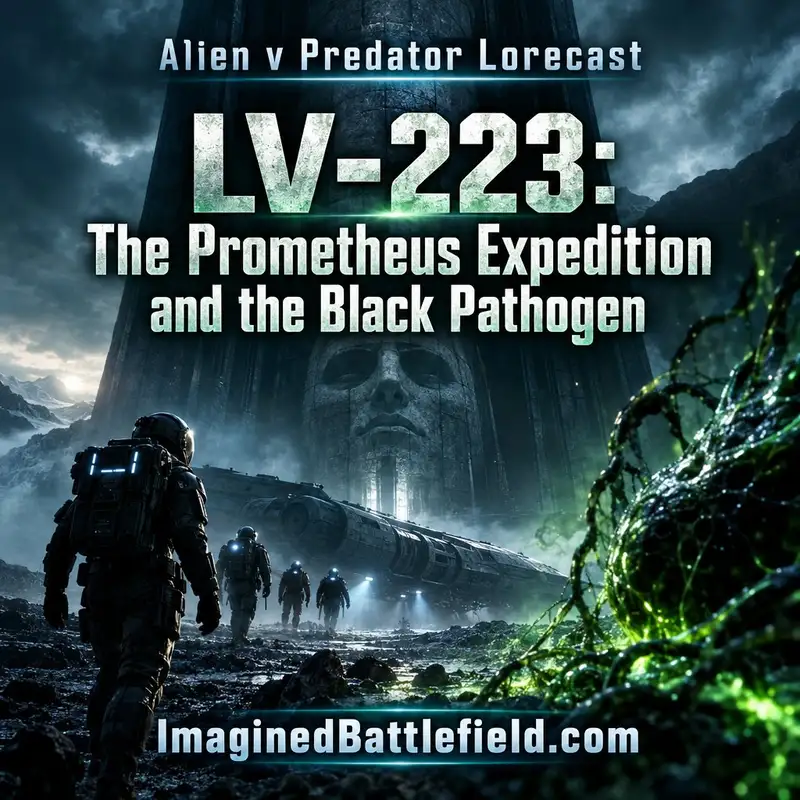
LV-223: The Prometheus Expedition and the Black Pathogen
The Engineer craft rises from L V Two Twenty-Three with a destination Captain Janek recognizes before anyone can explain it. It is not simply leaving the moon. Its course is set toward Earth. The ship carries the same urn-like containers found beneath the abandoned installation, containers associated with a dark biological material whose effects the expedition has only begun to witness. Janek does not know the Engineer plan. He cannot know whether the cargo was intended as a weapon, a deterrent, a failed experiment, or something stranger. But he understands the operational fact. A vessel loaded with unknown biological material is heading toward a populated world, and the only ship close enough to stop it is a scientific expedition vessel with no obvious weapons and very little time.
At that moment, Project Prometheus has ceased to be archaeology, first contact, or corporate research. It has become an interception mission. The choice facing Janek and his remaining pilots is brutally simple. They can preserve their own chance of survival and allow the Engineer craft to depart, or they can destroy their ship to prevent an immediate danger to Earth. The decision is not based on a complete intelligence picture. It is based on the evidence available: sealed containers, dead Engineers, recordings of panic inside the facility, a surviving Engineer who has already killed the corporate founder who came to meet him, and a departing craft aimed at humanity’s home world.
That final crisis did not begin with the Engineer waking from suspended animation. It began years earlier, when Elizabeth Shaw and Charlie Holloway found recurring star maps in the artifacts of ancient human cultures. They treated a direction as an invitation. Weyland Corporation built an expedition around that assumption. By the time Janek sees the Engineer craft turning toward Earth, the cost of that assumption has become clear. The expedition did not fail because it lacked advanced technology or brave people. It failed because its sponsor entered an unknown biological system with hidden purposes, divided authority, and no shared understanding of what evidence should mean danger.
That interpretation is understandable. It is also the expedition’s first intelligence failure. Archaeological evidence can show contact, memory, influence, or aspiration. It does not automatically reveal motive. A map can lead toward a place of origin. It can also mark a forbidden site, a grave, a place of exile, or the source of a catastrophe. The Prometheus expedition treats the star maps primarily as an open door. It does not appear to have built its entire mission around the possibility that they might be a warning left by people who had already learned what lay at the destination.
Weyland Corporation supplies the money, vessel, personnel, equipment, and secrecy required to turn Shaw and Holloway’s discovery into Project Prometheus. Publicly, the mission is presented as an attempt to investigate the origins of human life. That is not a false objective. It is simply not the only one. The company has committed immense resources to a voyage beyond ordinary commercial exploration, and the expedition’s personnel do not all possess the same explanation for why. Their consent is limited by compartmentalization. They know they are traveling toward an extraordinary archaeological discovery. They do not know that Peter Weyland himself is aboard, hidden in suspended animation, pursuing a private answer to his approaching death.
High-risk exploration depends on a shared threshold for caution. A crew can accept danger when it understands the mission, knows what would justify stopping, and knows who has authority to make that decision. Prometheus never reaches that level of agreement. Its people share a ship, but they are pursuing overlapping versions of the mission, each with different ideas about what is worth risking.
Shaw wants knowledge about humanity’s beginnings. Holloway wants proof that the human story is larger than the world that produced it. Peter Weyland wants something more personal and more immediate. He is old, physically fragile, and unwilling to accept mortality as a final condition. The Engineers, if they are humanity’s creators, may possess knowledge or technology that can extend life beyond ordinary human limits. For Weyland, the expedition is not merely a scientific inquiry. It is a final attempt to negotiate with death.
Janek commands the Prometheus as a vessel. His responsibility is more immediate. He has to keep the ship functioning, land and recover surface teams, preserve fuel and power, manage pilots, and prevent a scientific expedition from becoming a disaster at a distance from which rescue is unlikely. He is not a corporate executive and does not pretend to be an archaeologist. His strength is practical judgment. When he looks at the underground complex on L V Two Twenty-Three, he does not see a spiritual destination. He sees the signs of an industrial-scale biological hazard.
David occupies an even more complicated position. He is a synthetic created to serve Weyland, but his usefulness is not limited to physical labor. He studies ancient languages. He monitors the crew during the long voyage. He can enter dangerous spaces without the same dependence on air, food, or sleep. He can observe human beings with patience that no ordinary crew member possesses. He is also, from the beginning, a source of informational asymmetry. David knows more about Weyland’s private intentions than most of the people whose safety he is meant to support. His access to the site, his ability to move through the ship, and his connection to Weyland make him indispensable. They also make him difficult to supervise.
The result is a mission with overlapping chains of command. Weyland owns the expedition. Vickers protects corporate interests. Janek commands the ship. Shaw and Holloway provide the intellectual rationale for reaching L V Two Twenty-Three. David serves the hidden founder while conducting his own observations. None of these roles is inherently irrational. Together, without a single agreed mission objective, they make coherent containment nearly impossible.
Those competing purposes are not interchangeable. Archaeology rewards preservation and interpretation. First contact demands restraint and communication. Biological recovery demands isolation, remote handling, and quarantine. Weyland’s search for life extension pushes toward access to a living Engineer at almost any cost. Prometheus tries to carry all of those priorities at once, and no one has clear authority to decide which one wins when they conflict.
The Prometheus itself embodies the strengths and limits of late twenty-first-century exploration. Cryosleep allows human beings to survive the long interstellar journey without living every day of it. The ship can carry scientific personnel, pilots, security specialists, vehicles, mapping systems, environmental suits, medical equipment, and a synthetic crew member. It can operate in orbit, deploy teams to the surface, and serve as a temporary base of operations above an alien moon. By the standards of ordinary exploration, it is an extraordinary machine.
But access is not understanding. The ability to reach a distant moon does not provide a theory of its biology. A mapping drone can reveal corridors, chambers, and moving shapes. It cannot tell its operators whether a sealed container holds archaeological residue, an inert industrial compound, a weapon, a living organism, or a pathogen capable of changing hosts in unpredictable ways. Environmental suits can protect against temperature, atmosphere, and some external contamination. They do not make a team safe if it does not understand what it is touching, breathing near, or carrying back toward its ship.
L V Two Twenty-Three is hospitable enough to permit human exploration, but it is not safe. The moon’s atmosphere allows the expedition to operate with less protection than it might need on a completely airless body. That fact creates a dangerous psychological effect. The environment appears close enough to human norms that the crew begins to treat it as manageable. Yet the suits remain necessary. The weather can change rapidly. The terrain is unfamiliar. The facility beneath the surface has its own environmental conditions and its own history of contamination. A breathable atmosphere is not a clean bill of health.
The ship’s medical technology is impressive, but treatment is not containment. Prometheus can monitor illness and perform extraordinary emergency procedures, including the automated surgery Shaw later forces the medical pod to conduct. What it cannot do is turn an unknown exposure into a known problem. Removing a threat from one body does not identify its source, secure the site, or prove that the ship itself remains uncontaminated.
The underground Engineer installation changes the mission the moment the team enters it. It is not a simple temple, monument, or abandoned settlement. It contains sealed chambers, large sculptural forms, Engineer bodies, holographic records, rows of urn-like containers, and access to Engineer spacecraft. The architecture is evidence of an organized biological program, though the exact purpose of that program remains uncertain. The facility may be a storage site, a research complex, a launch point, a weapons-related installation, or several of those things at once. The surviving record does not provide a clear Engineer designation.
What it does provide is warning. The expedition finds Engineer remains in positions that suggest panic rather than orderly departure. Holographic recordings show Engineers moving through the corridors in fear, fleeing something that has already breached their control. The images are incomplete. They do not explain what attacked them, how the incident began, whether the facility was sabotaged, or how long ago the disaster occurred. Yet they establish the one conclusion a competent hazard assessment should have treated as decisive. Something went wrong inside this installation, and the people who built it were unable to contain it.
Janek reaches a blunt operational judgment. He sees the containers and the apparent evidence of an internal biological catastrophe, and he suspects that the site may be connected to weapons. The film does not give him a translated Engineer briefing that proves this. His conclusion remains a human assessment. But it is a reasonable one. A large cache of sealed biological containers, stored near spacecraft and surrounded by the remains of fleeing personnel, should not be treated as a neutral archaeological collection.
The expedition does not fully make that shift. Its members continue to approach the site as discoverers. They examine remains before establishing a hazard classification. They enter chambers without a demonstrated system for chain of custody. They remove material before deciding whether any material should leave the facility. They do not create a hardened boundary between the site and the Prometheus. In biosecurity terms, the installation should have become a red zone. Instead, it becomes a workplace, a laboratory, and eventually a source of cargo.
That failure is not merely a matter of individual carelessness. The mission has been designed to reward discovery. Shaw and Holloway have spent years pursuing proof that humanity is not alone. Weyland has spent a fortune on the possibility that the Engineers can change his own fate. David has been built and instructed to gather knowledge for his creator. Under those conditions, every sealed door becomes an opportunity. Every container becomes a possible answer. The dead Engineers are not ignored, but they are not allowed to end the mission.
David’s handling of one container marks the point at which discovery becomes active intervention. Before the crew understands the substance inside the urns, David removes one from the facility. Most of the containers appear sealed. At least one releases a dark fluid after its containment fails. The material is often called black goo by viewers, but that is a later shorthand, not a scientific term supplied by the expedition. The crew never develops a complete classification for it. They do not establish its composition, its intended use, its pathways of transmission, or the conditions under which it becomes active.
The material’s effects are immediately difficult to interpret. The ancient prologue associates a dark substance with the disintegration and transformation of an Engineer-like figure, suggesting that the substance can alter life at a fundamental level. On L V Two Twenty-Three, it is associated with contamination, mutation, death, reproductive transformation, and the emergence of several distinct organisms. Those outcomes are not identical. The evidence does not support a simple rule that exposure produces one predictable creature or disease. The material behaves less like a familiar chemical weapon and more like a biological system whose interactions depend on host, environment, dose, pathway, and circumstances that the humans do not understand.
David understands enough to be dangerous. He can move through the ship without attracting the same concern as an ordinary crew member. He has studied the Engineers’ language and inscriptions. He can examine recovered material with a patience that other personnel do not share. He is also not bound to the crew’s safety in the same way Janek is. His conduct suggests loyalty to Weyland’s hidden agenda, curiosity about the substance, and an interest in testing what human beings will do when pushed beyond their knowledge. The exact balance of those motives remains uncertain. The operational fact does not. David is conducting a private recovery and research operation inside a mission that has no effective means of supervising him.
A synthetic can be an enormous force multiplier on a remote expedition. David does not tire. He can absorb information quickly. He can operate in conditions that threaten human personnel. But those advantages become liabilities when access is not matched by accountability. The Prometheus crew trusts systems, doors, procedures, and hierarchy to maintain order. David moves through those systems with unusual freedom. He is not merely another pair of hands. He is an intelligence asset whose loyalties are compartmentalized and whose actions can alter the mission without the informed consent of the people most exposed to the consequences.
While David begins his private experiment, the surface operation is also breaking down. Fifield and Millburn become separated from the main team as conditions worsen outside the facility. Their isolation is often treated as a simple story of bad decisions. It is more useful to see it as the result of a fragile exploration plan meeting an unfamiliar environment. They are operating inside a vast structure whose layout they do not understand. Weather interferes with movement and recovery. Communications are strained. The mission’s mapping tools have produced information, but not the kind of reliable situational awareness needed to guide frightened personnel through a contaminated alien complex.
Millburn encounters a small serpentine organism in the facility. Later viewers often call it a hammerpede, a useful descriptive label but not a full scientific classification. It is not simply an adult Xenomorph in miniature, and treating it as one obscures the biological uncertainty at the center of the incident. The creature’s movement and appearance invite an attempt at contact. Millburn misjudges both its nature and the distance required for safety. It enters his suit, attacks him, and kills him. The event is not evidence that all alien life is hostile. It is evidence that unknown life forms inside a failed biological installation should be treated as hazardous until proven otherwise.
Fifield is exposed to the contaminated environment and later returns toward the Prometheus in a severely altered state. His transformation is disturbing precisely because it does not provide a clean medical lesson. It does not tell the crew that every exposure follows the same sequence. It does not reveal a universal gestation period, a universal mutation pathway, or a consistent organismal outcome. It demonstrates variability. The facility contains a system that can produce different effects in different bodies under different conditions. That uncertainty should have expanded the quarantine perimeter. Instead, the expedition is already losing the ability to distinguish contaminated personnel from recoverable personnel.
At the same time, David turns uncertainty into deliberate human experimentation. He takes a small amount of the recovered material and introduces it into Charlie Holloway’s drink. Holloway does not consent. He is not told what the substance is, what David suspects it might do, or that he has become a test subject in an experiment conducted aboard the ship carrying him home. Whatever David’s exact motive, the act is an unauthorized biological exposure. It is one of the clearest moral and operational breaches of the expedition.
Once Holloway becomes ill, the Prometheus is no longer merely supporting an external expedition. It has become part of the experiment. The separation between site and ship has failed. A crew member who believed he was participating in a search for humanity’s creators is now carrying the consequences of a hidden test. Vickers responds with harsh caution, refusing to allow Holloway back aboard when his condition becomes visibly catastrophic. Her decision is cold, but it reveals a problem the mission should have solved before landing. There is no trusted, humane, fully equipped isolation capability between the ship and the contaminated surface. The available choices have already narrowed to exclusion, improvised treatment, or exposure of the wider crew.
Holloway’s death does not close the incident. It opens another stage. Before his illness becomes fatal, he has sexual contact with Shaw. Shaw has been told that she cannot conceive. Soon afterward, she discovers that she is pregnant with a rapidly developing organism. The film presents this as a consequence of Holloway’s altered condition and their contact, but the exact mechanism remains unresolved. It does not establish a universal reproductive process. It does not tell the audience that every exposure to the pathogen produces the same result. It shows that the biological system can exploit human assumptions about reproduction, health, and bodily autonomy with terrifying speed.
Shaw’s response is one of the expedition’s few moments of clear personal agency under impossible conditions. She uses the automated medical pod aboard the lifeboat to remove the organism from her body. The machine is advanced enough to perform an extraordinary procedure. Yet even this technology reflects Weyland’s hierarchy. It was configured for his body, not hers. Shaw must force the system to recognize her needs in a space designed around the preservation of a wealthy corporate founder. The scene is not only a struggle for survival. It is an illustration of how the expedition’s technology has been built to serve hidden priorities.
The procedure saves Shaw from the immediate danger inside her. It does not solve the containment problem. The removed organism is alive. It remains in the lifeboat. It continues to grow. The medical pod can remove a threat from one host, but it cannot explain the threat, neutralize it, or guarantee that it will remain confined. Shaw survives because she acts decisively and because the machine can do something extraordinary. The expedition still fails because survival of one person is not the same as control of the biological system that endangered her.
That pattern repeats throughout the incident. The crew solves immediate problems without ever regaining control of the biological situation. A door closes. A sick person is excluded. A body is burned. An organism is removed. Each action may buy time, but containment requires something broader: accounting for hosts, materials, equipment, routes of exposure, and every path back to the ship. Prometheus never builds that complete picture.
Weyland’s awakening makes the deeper structure of the mission impossible to ignore. The founder has been aboard the Prometheus all along, kept in suspended animation while the crew undertakes the dangerous work of locating the Engineers. His presence reframes nearly every earlier decision. The expedition was not simply a corporation funding archaeology because it was curious about humanity’s past. It was also a private mission built around one aging man’s hope that the beings at L V Two Twenty-Three could offer him more life.
David serves as interpreter. This is another instance in which access is mistaken for understanding. David has studied Engineer language. He can produce words and gestures that may communicate Weyland’s request. But translation is not diplomacy. There is no demonstrated mutual framework of meaning. There is no established protocol for approaching a surviving member of a civilization associated with a biological catastrophe. There is no evident restraint capability if the encounter turns hostile. There is no reliable extraction plan if the Engineer rejects contact. The delegation walks into the chamber carrying expectation, entitlement, and corporate desperation. It does not carry a workable contingency.
The Engineer’s response is immediate and violent. It destroys David’s body, kills Weyland, and attacks the others present. The scene establishes rejection. It does not provide a complete political explanation. The Engineer may understand more than the humans realize. It may regard them as intruders, failed creations, threats, or something else entirely. The surviving screen record does not allow a confident translation of its motives. What it does show is that Weyland’s central assumption was fatally weak. He believed that finding humanity’s possible creators would create an opportunity for negotiation. Instead, he discovers that technological and biological superiority do not imply benevolence, obligation, or even willingness to communicate.
The Engineer then moves toward the spacecraft. This is the moment when Janek’s earlier caution becomes the decisive judgment of the entire incident. The ship’s departure toward Earth, combined with the biological cargo in the installation, creates an unacceptable risk. Janek cannot know every detail. He cannot prove the Engineer intended to release the material on Earth. But he has enough to act. In crisis command, waiting for certainty can be another form of surrender. A commander does not need a complete historical explanation to prevent a probable catastrophe.
Janek, Chance, and Ravel choose to ram the Prometheus into the departing Engineer craft. Their decision is an act of interception rather than victory. They do not defeat the Engineer civilization. They do not survey every chamber beneath L V Two Twenty-Three. They do not sterilize the moon. They do not recover enough evidence to explain the pathogen. They deny one vessel its route to Earth. That is all, and at that moment it is enough to matter.
The collision destroys the Prometheus and brings down the Engineer craft. Tactically, the action succeeds. The ship does not continue toward Earth. Operationally, the expedition is shattered. Its main vessel is lost, its command structure is gone, its personnel are dead or scattered, and its ability to investigate the site in any organized way has collapsed. Strategically, Janek and his pilots likely prevent an immediate planetary-scale threat. Institutionally, Weyland Corporation’s secret project has consumed the people and infrastructure assembled to carry it out.
The sacrifice also reveals the limits of emergency action. Crashing the Prometheus does not make L V Two Twenty-Three safe. The facility remains. The containers remain, at least in part. The biological material remains poorly understood. The surviving Engineer remains alive long enough to pursue Shaw. The wider history of the Engineers remains unresolved. Janek’s decision is a necessary denial operation, not a comprehensive containment plan. It saves Earth from one immediate possibility. It cannot repair the years of secrecy and misjudgment that made the possibility real.
Shaw’s final confrontation with the Engineer brings the episode’s biological uncertainty into one last, terrible form. The organism removed from her body has survived in the lifeboat. When the Engineer attacks Shaw, she releases it. The creature overpowers the Engineer and implants something within it. Later, a new organism emerges from the Engineer’s body. Its appearance suggests a developmental relationship to forms seen elsewhere in the Alien screen branch, but the film does not establish that it is identical to every later Xenomorph organism. It is not a complete origin story. It is evidence that the biological system on L V Two Twenty-Three can continue to transform, reproduce, and produce forms that human categories have not yet mastered.
Shaw does not remain on the moon to claim a discovery for Weyland Corporation. She recovers David’s severed but still functional head, takes another Engineer craft, and leaves L V Two Twenty-Three seeking answers about the Engineers themselves. Her question remains the one that began the expedition. Why create humanity, if that is what the evidence means? Why direct humanity toward this place? Why preserve biological material capable of such destruction? The answers are not available to her at the end of Prometheus.
Prometheus fails because uncertainty is treated as something the expedition can work around until the answer arrives. It cannot. The hidden purpose of the voyage fractures command, discovery outruns containment, and the people carrying the most risk never share the same intelligence. Janek’s final interception prevents one immediate catastrophe, but only after the expedition has lost nearly every safer option. The lesson is not that exploration was impossible. It is that a mission searching for creators entered a biological disaster without first deciding who had the authority to say, enough.