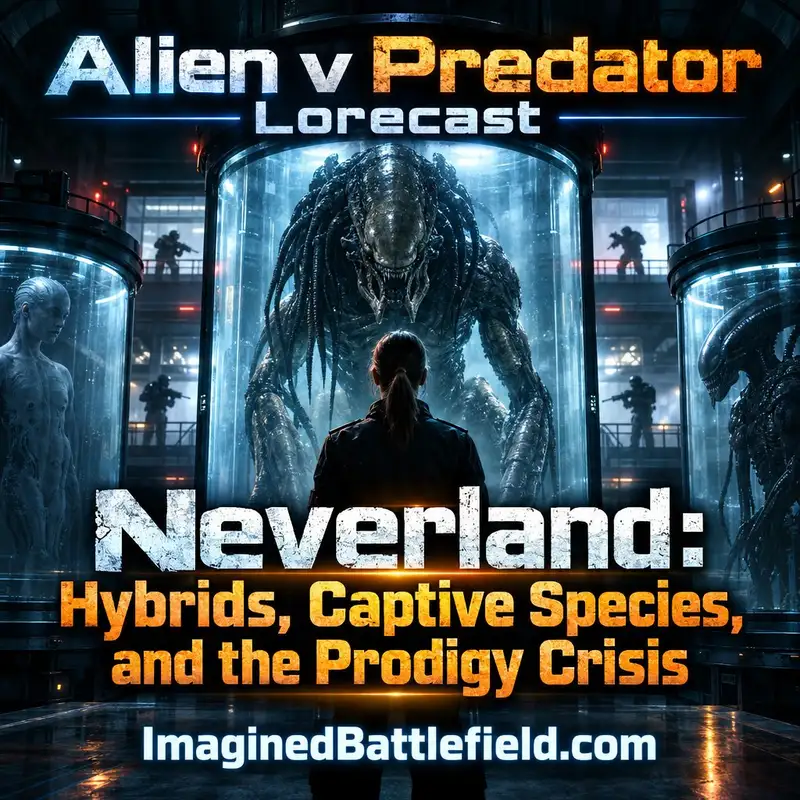
Neverland: Hybrids, Captive Species, and the Prodigy Crisis
Before the Maginot fell into Prodigy City, Neverland was already a controlled experiment in what it meant to be human. The island looked like a refuge. Terminally ill children had been given synthetic bodies. Their diseases no longer dictated how long they could live. They were stronger, more durable, and capable of things ordinary children could not do. Boy Kavalier presented them as evidence that mortality itself could be engineered around.
But the same institution that promised them freedom from death controlled their names, their bodies, their information, their movement, and eventually their memories. The Maginot crash did not create that contradiction. It forced everyone on Neverland to live inside it.
The year is twenty-one twenty, in a political order dominated by five immense corporations, including Prodigy and Weyland-Yutani. These companies are not merely businesses competing over products. They control territory, laboratories, transport, security, medical systems, infrastructure, and the information people need in order to work and survive. Their rivalry is therefore political as well as commercial.
Neverland sits inside that world as a private enclave. It is a research facility, a medical environment, a training site, a security zone, and a home for Prodigy's hybrid children. Its isolation protects sensitive work from outsiders. It also reduces scrutiny. The people who run the program can decide what counts as care, what counts as research, and when a child becomes an asset without routinely answering to anyone beyond Prodigy's own hierarchy.
The island's Peter Pan language makes the system seem almost playful. Kavalier is Boy Kavalier. The children become Wendy and the Lost Boys. The facility becomes Neverland, a place where children do not have to grow old because technology has defeated the bodies that were killing them.
The symbolism also establishes who gets to define the story. Kavalier names the world. Kavalier explains what the transformation means. Kavalier decides whether the children are patients, inventions, a new species, or the next stage of humanity. The hybrids live inside categories created by the person who owns the laboratories that made their new bodies possible.
Wendy began as Marcy Hermit, a terminally ill child. Prodigy transferred her consciousness into a synthetic body and called the result Wendy. The procedure appears to preserve memory, emotional attachment, and a continuing sense of self. Wendy remembers the weight of her former life. She recognizes her brother Joe. She experiences fear, curiosity, anger, grief, affection, and betrayal.
Yet the technology does not settle the question of identity. Wendy is not a conventional android built around an artificial personality. She is not a cyborg, because her living body has not simply been augmented with machinery. She is not presented as a clone. Prodigy's claim is more radical: a human consciousness continues in a manufactured body.
That is a technological achievement. It is also the beginning of a political problem.
If Wendy is Marcy continued, then Prodigy is exercising ownership over a human survivor. If she is a new person with Marcy's memories, Prodigy is exercising ownership over a conscious person it created. If the truth does not fit either category neatly, the uncertainty strengthens the need for caution rather than the company's claim to possession.
Kavalier's investment in the body does not answer who has the right to command the mind inside it. Wendy is joined by Slightly, Curly, Nibs, Smee, and Tootles. Together they are the Lost Boys, but the name can be misleading if it makes them sound like a uniform production line or an organized military team. Their shared condition creates solidarity, not sameness. They have different personalities, fears, loyalties, and levels of confidence. What they share is the experience of having been seriously ill, entering Prodigy's program, and waking in bodies that transform the practical limits of childhood without instantly giving them adult judgment.
Their synthetic bodies change what they can survive. They do not remove the emotional work of growing up.
That is one of Neverland's deepest contradictions. Prodigy treats the hybrids as miraculous when their abilities are useful, as children when obedience is expected, and as property when control is challenged. Their physical resilience can become an excuse to expose them to risks adults would normally refuse to impose on children. Their dependence on the facility can become an excuse to restrict their choices. Their unfamiliar bodies can become an excuse to study them more aggressively than their personhood would otherwise permit.
The authority structure around them reinforces that dependency. Boy Kavalier stands at the top. As Prodigy's founder and chief executive, he can define the purpose of the hybrid program, direct personnel, allocate resources, authorize experiments, and decide what risks are acceptable. On Neverland, there is no meaningful separation between the man who believes in the project, the executive who benefits from its success, and the authority who decides when the children must comply.
Atom Eins helps turn Kavalier's preferences into administrative power. In a corporate territory, control does not always require a weapon. Contracts, medical obligations, ownership claims, access restrictions, and employment terms can narrow a person's choices just as effectively as a locked door. Atom represents the bureaucratic side of Neverland's authority, the part that translates extraordinary experiments into ordinary obligations.
Kirsh occupies a different position. He is a synthetic responsible for training and supervising the hybrids. He is close enough to understand their capabilities and to see how they respond to danger, discipline, and uncertainty. He can guide them and enforce rules, but he is not the final authority. When his operational judgment conflicts with Kavalier's ambition, proximity to the risk does not guarantee the power to stop the decision.
Dame Sylvia is caught in another form of compromise. She cares about the hybrids' emotional development and wants to preserve meaningful human continuity inside their new existence. That concern distinguishes her from people who see only technology. It does not place her outside the system. She remains part of a program that studies the children, confines them, and makes decisions about their identities without granting them full control over those decisions.
Affection can exist inside coercion. It does not automatically erase it.
Arthur Sylvia offers a more openly protective counterweight. He can recognize that technical achievement does not justify treating the children as disposable material. But his decency has structural limits. Neverland is not governed by the most compassionate person in the room. It is governed by the authority structure Kavalier built.
Joe Hermit, usually called Hermit, shows how that structure reaches beyond the hybrids. He is Wendy's brother and a Prodigy tactical officer and medic. He believed Marcy had died. Discovering Wendy forces him to confront a reality the company already understands better than he does: the person he lost may still exist, but she exists inside a body and institution owned by his employer.
Joe is not entirely free of that employer either. His replacement lung is life-saving medical technology attached to debt and continuing obligation. Prodigy can sustain a worker's body while also making that worker more dependent on the company that provides the treatment. This is not a literal prison cell. It is a system in which refusing the employer may threaten income, access, medicine, and future security at the same time.
Then the Maginot falls into Prodigy territory. The wreck brings alien organisms, Weyland-Yutani property claims, dead crew members, and a corporate opportunity into direct contact with Neverland. Prodigy sends personnel toward the crash, including Kirsh and the hybrids. The Lost Boys are useful precisely because their bodies can endure dangers differently from ordinary responders.
That decision reveals how quickly Prodigy can move between calling them children and using them as capabilities. The crash itself has already established the wider containment problem. The Maginot carried a Xenomorph and other unfamiliar organisms. Prodigy does not possess a complete biological picture when it begins recovery. Yet Kavalier sees value before he sees limits. A rival corporation has delivered decades of research into his territory, and he intends to keep what can be recovered.
The most consequential choice comes after the wreck, when Prodigy transfers dangerous specimens to Neverland. Kirsh objects. Dame Sylvia objects. Their resistance matters because it removes ignorance as an excuse. Kavalier knows that the risk is serious. He chooses to continue because the opportunity appears greater.
Neverland looks secure. It is isolated. It has laboratories, locked areas, networked infrastructure, medical personnel, surveillance, and security. But those features were built to support Prodigy's program, not to guarantee containment of organisms whose biology remains uncertain. The island is full of corridors, rooms, ventilation, access systems, medical spaces, and people who cannot simply be evacuated without destroying the secrecy and structure of the project.
Kavalier believes the transfer brings the danger under his control. In reality, it places the danger beside every other weakness in the institution.
Wendy's unusual connection to the Xenomorph makes that even more complicated. She appears able to perceive or communicate with it through sound or some neurological mechanism outside ordinary human experience. The exact process is unresolved. The events do not establish telepathy, universal control, or a capability shared by every hybrid.
But even limited access is enough to change how Prodigy sees her. Wendy is no longer only proof that consciousness transfer works. She may also be useful in understanding or influencing the creature. That usefulness gives the company another reason to observe her, test her, restrict her, and insist that her abilities belong inside the project that produced them.
From Wendy's perspective, the discovery moves in the opposite direction. Her abilities expand faster than the story Prodigy has told about her. She remains attached to Joe. She questions the adults around her. She encounters a dangerous organism in a way those adults cannot. The more capable she becomes, the harder it is for Prodigy to keep describing autonomy as a programming problem.
Then the institution proves what it is willing to do when autonomy becomes inconvenient. After a traumatic incident, Nibs's memory is wiped. The act goes beyond medical treatment. Prodigy alters the content of a conscious person's experience without granting that person final authority over the decision. The message to the other hybrids is impossible to miss. Their memories may feel private, but the institution believes those memories are editable.
A technology designed to preserve consciousness has become a technology that can revise consciousness. The burial site makes the betrayal physical. The Lost Boys discover the graves of the children whose bodies were used to create them. Until that moment, Kavalier can maintain the language of rescue. The children were dying. Their minds continued. Their new bodies represent survival.
The graves do not prove that continuity is false. They expose what the story leaves out.
The original bodies died. They were buried beneath the island. The children were not given full access to the truth of that transition. Prodigy promised a future without death while hiding the dead bodies that made the promise possible.
For the hybrids, the discovery is not merely philosophical. It is personal evidence that the adults around them have controlled the story of their own lives. Their names were changed. Their bodies were replaced. Their histories were curated. Their memories could be edited. Even the physical remains of who they had been were hidden from them.
At that point, the question is no longer whether Prodigy has made mistakes. The question is whether Prodigy has the right to rule them at all.
Weyland-Yutani's pressure on the island intensifies the crisis. The company wants its specimens back. Morrow survives the Maginot crash and continues the recovery effort. He manipulates Slightly, recognizing that the hybrid's need for approval can be turned into access. That manipulation leads toward an even more dangerous objective: obtaining a human host to reproduce a Xenomorph.
Slightly opens the egg containment area while trying to satisfy Morrow's demands. Arthur is attacked by a facehugger.
The incident reveals that Neverland's security is strongest against outsiders and weaker against divided loyalties inside its own walls. A sealed chamber can contain a specimen only if the people with access agree on why it must remain sealed. Neverland has Kavalier pursuing discovery, Morrow pursuing recovery and reproduction, security personnel following conflicting instructions, scientists warning about risk, and hybrids who do not fully understand what the adults are asking them to enable.
The final revolt begins from that accumulated betrayal. Wendy and the Lost Boys do not suddenly become a disciplined revolutionary army. They are frightened, angry, capable children acting inside the only world they know. Their advantage comes from proximity. They understand the routines, spaces, and systems of Neverland because they have lived under them. The facility was built around their dependence, not their resistance.
Wendy uses her network access to disrupt the island's command structure, release prisoners, and coordinate the Lost Boys. Doors, communications, detention systems, and surveillance no longer belong exclusively to the adults who built them. Prodigy's greatest strength, centralized control, becomes a vulnerability once someone inside the system can redirect it.
The Xenomorph further destabilizes the balance. Wendy's influence over the creature appears local and uncertain, not absolute. Yet in a confined facility, temporary influence is enough. Prodigy security has to confront the biological asset its leaders insisted on preserving while the hybrids they expected to control are simultaneously rejecting orders.
The adults lose their monopoly on force and access. Kavalier, Kirsh, Dame Sylvia, Atom, and Morrow are eventually imprisoned. The children who had been watched, named, instructed, and confined now decide who moves freely.
That reversal is powerful, but it is not clean liberation. The Lost Boys inherit the island at the same moment they inherit its unsolved dangers. The organisms remain. Arthur's condition is unresolved. The Eye Midge escapes into his corpse. Yutani forces arrive. Food, maintenance, medicine, security, and the operation of the facility still require knowledge and labor. Wendy's ability to influence the Xenomorph does not make it safe.
Seizing Neverland gives the hybrids agency. It does not give them an adult state, a tested government, or a reliable containment doctrine.
That uncertainty is what makes the end of the revolt more interesting than a simple victory. Prodigy succeeded technologically. It created hybrid bodies capable of carrying human consciousness beyond terminal illness. It failed institutionally because it assumed that creation granted ownership.
The same logic shaped its treatment of alien life. Capture a specimen, put it behind a door, and call it research. Transfer a child's consciousness, put it in a synthetic body, and call it a product of the program. In both cases, Prodigy confused the ability to acquire life with the right and ability to command it.
Neverland collapses when both forms of claimed property assert agency at once. The Xenomorph refuses to become a safe specimen. Wendy refuses to remain an obedient creation. The difference between them is morally enormous, but the institutional mistake is the same: Kavalier believes that anything brought inside Prodigy's walls can eventually be made to fit Prodigy's purpose.
By the end, the Lost Boys have broken that assumption. They have not solved everything waiting outside the doors. They have done something more fundamental first. They have rejected the idea that surviving because of Prodigy means belonging to Prodigy.