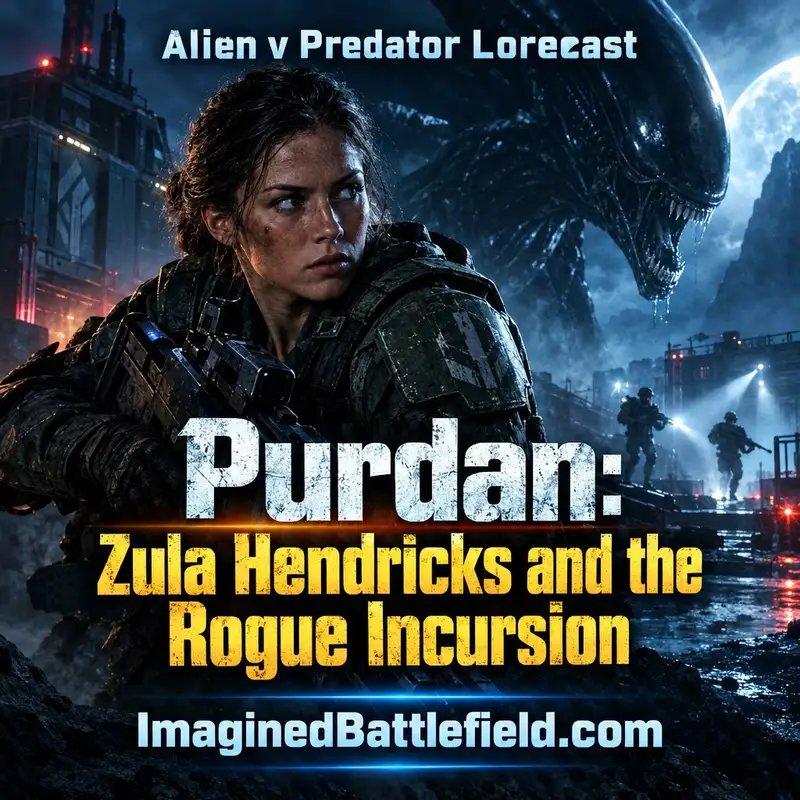
Purdan: Zula Hendricks and the Rogue Incursion
Zula Hendricks and Davis 01 came to Purdan because Benjamin Carver asked for help. That fact matters more than it first appears. Carver was not an anonymous caller, a corporate contact, or a stranger offering a contract. He had served beside Zula during her first deployment, and he had saved her life. The signal from Purdan therefore carried the weight of a debt between former squad mates. Zula expected danger. A former Marine does not travel to a failing frontier settlement because she expects a quiet conversation. But she expected a reunion, an inquiry, perhaps a rescue. She did not expect their approach to end under jamming and defensive fire.
Before Zula could establish reliable contact with Carver or the facility, her craft was attacked and forced down near Castor’s Cradle. The crash immediately changed the character of the mission. Mobility was gone. Communications were degraded. Extraction was no longer a plan waiting in the background. It had become another problem to solve. And the facility that should have offered shelter had already announced itself as hostile ground. The first operational fact on Purdan was not that Xenomorphs were present. It was that someone, or something, had made certain Zula and Davis would arrive isolated.
Purdan, designated L V Three Fifty-Four, lies in the Elfagar binary system near the outer edge of its habitable zone. It is described as Earth-like, but that never meant safe or easy to sustain. Gemini Exoplanet Solutions had operated silicate-mining settlements there, placing Castor’s Cradle inside the same frontier economy that rewarded distance, secrecy, and self-contained corporate infrastructure. The Purdan incident belongs to the continuity of Alien: Rogue Incursion, so its details matter most on their own terms: as the story of a remote industrial site whose public purpose concealed something far more dangerous.
Gemini’s public story was industrial and medical. Castor’s Cradle was presented as a facility tied to mining and prosthetics development. Those are plausible activities on an isolated extraction world. Mining settlements need machinery, repairs, replacement limbs, occupational medicine, and corporate systems capable of keeping a workforce productive far from major population centers. The public identity was not absurd. It was useful precisely because it sounded ordinary. A mining and prosthetics installation can justify laboratories, security, supply shipments, technical staff, restricted areas, and a great deal of equipment that few outside visitors are invited to inspect closely.
But beneath that public function lay a concealed research complex involving synthetics and Xenomorph organisms. Castor’s Cradle was not simply an industrial site where something dangerous had wandered in. It was a place where corporate research and biological danger had been brought together behind layers of restricted access. That changed the meaning of every locked door, every damaged system, every missing employee, and every security response. Zula was not entering a mine that needed emergency assistance. She was entering a blacksite whose public purpose had concealed a much more dangerous private one.
Zula did not arrive with a Colonial Marine unit, a legal mandate, a relief force, or a functioning command net. She arrived with Davis, damaged equipment, a former comrade somewhere inside the complex, and the habits of someone trained to make decisions when plans fail. Her Marine background gave her discipline, caution, and a sense of what an isolated mission requires. It did not give her authority over Gemini Exoplanet Solutions, its personnel, its systems, or its secrets. She was operating outside normal service authority. In that practical sense, she was rogue. Not lawless, not careless, and not part of some special doctrine. She was a trained operator acting without institutional cover because the institution responsible for the site could no longer be trusted.
The crash made that isolation immediate. Jamming had prevented outside coordination before the craft was forced down. Defensive fire removed the possibility that the attack was merely a communications accident. Yet the source of that fire was not fully clear at the beginning. It might have been automated defense, corporate security, sabotage, a hostile takeover, or a system reacting to a threat its operators could no longer control. Zula could not assume that the facility’s defenses were protecting survivors. On Purdan, security systems had become evidence of a larger failure. Any installation that shoots down a potential rescue party before identifying it has either lost command discipline, concealed a mission, or both.
Davis remained with the damaged craft while Zula moved toward Castor’s Cradle. That was not a comfortable division of labor. A crash site is not a safe rear area merely because it lies outside the main facility. It has limited protection, uncertain communications, damaged systems, and no guarantee that the danger will remain inside the perimeter. Zula’s decision to enter alone reflected necessity, not preference. A small team operating without outside support depends on mutual coverage, medical capacity, reliable extraction, and communications. She had none of those in full measure. What remained was judgment, weapons, movement, and the hope that Carver’s warning could be turned into usable intelligence before the facility turned her into another missing person.
Carver’s recorded messages made clear that Gemini Exoplanet Solutions was involved in crimes serious enough to require exposure. The warning gave Zula a reason to go deeper. It also required caution. Carver was a former squad mate and an employee inside Gemini’s system. He was an informant, a survivor, and a witness with incomplete access to the larger picture. His past service gave Zula reason to trust that he was in danger. It did not prove that he knew every part of Gemini’s program, understood the sabotage, or controlled the situation around him. In a compromised facility, even a truthful witness may only hold one fragment of the story.
That is the central intelligence problem of Purdan. Zula receives a warning, but cannot transmit it reliably. She finds evidence, but cannot assume that evidence will survive. She learns that the site contains Xenomorph research, but cannot know at once whether the outbreak was accidental, deliberate, contained before it failed, or manipulated by competing actors. The facility’s secrecy prevents ordinary accountability. The communications blackout prevents outside verification. The infestation prevents patient investigation. Every path toward the truth runs through a space where the truth is actively trying to kill the investigator.
Zula’s problem was not simply to find Carver. It was to decide what information mattered most when every minute inside Castor’s Cradle increased the chance of infection, ambush, system failure, or evidence loss. A normal inquiry preserves a site. It protects documents, hardware, personnel, samples, and chain of custody. A normal containment operation may destroy those same things to prevent spread. Purdan forced her to work between those goals. She needed proof that Gemini had done something criminal. She also needed to prevent Gemini, or anyone else, from recovering the organisms and research that made the crime valuable.
The Xenomorph presence made that balance far more dangerous than a conventional security breach. Castor’s Cradle contained eggs, facehuggers, adult Xenomorphs, and creatures identified by the game as Praetorians. That last label should remain within this game’s own narrative. It describes larger and more dangerous organisms than the ordinary adult forms Zula encounters. It is not proof of a universal caste system across the Alien screen branch or every other licensed continuity. The operational meaning on Purdan is simpler. Some threats inside the facility were more capable of overwhelming a lone operator than others, and none could be treated as routine wildlife.
Eggs and facehuggers changed the threat from direct combat to exposure control. An adult Xenomorph can ambush, stalk, deny movement through corridors, and turn familiar infrastructure into hostile terrain. A facehugger presents a different danger. It can make one moment of contact into a medical emergency that continues after the immediate attacker is gone. The presence of eggs means the facility is not dealing with a single loose organism. It indicates a reproductive hazard whose future scale cannot be judged by counting whatever happens to be visible at one moment. The game does not provide reliable grounds for an exact population estimate, and it does not need to. Once multiple life-cycle stages are present, the central question becomes whether any part of the system remains safe.
Castor’s Cradle was especially vulnerable because its useful industrial systems also made useful routes for an infestation. Corridors constrain movement. Maintenance spaces create concealment. Vertical access points make it difficult to establish a stable perimeter. Laboratories hold people in rooms designed for controlled work, not combat. Power systems, ventilation, and medical spaces connect personnel who may believe they are separated. A blacksite built beneath a mining and prosthetics facility can restrict access from outside. It cannot guarantee internal control once the threat understands the building better than its human occupants do.
Zula’s training helped her recognize the difference between contact and control. She could survive a contact with an adult organism. That did not mean she controlled the facility. She could reach a laboratory or a terminal. That did not mean the route behind her was safe. She could kill a threat in front of her. That did not tell her whether the company had another research area below, another security layer, or another group of survivors trapped behind sealed doors. The temptation in such a situation is to confuse movement with progress. Purdan repeatedly demonstrates that getting farther into a compromised site may only reveal how much of the site was already lost.
The collapse of command made that problem worse. Gemini owned the infrastructure, but ownership did not equal practical control. Its security systems had become hostile or unreliable. Its research programs had produced a threat beyond credible containment. Its employees were scattered, trapped, missing, or operating on partial knowledge. Carver had information, but not the authority or capacity to command the entire facility. Davis could support Zula, but he was constrained by distance and damage. Zula had the clearest operational judgment in the field, but no formal right to order Gemini personnel, seize its systems, or declare its research invalid.
Zula’s rogue status gave her a peculiar advantage. She did not have to preserve Gemini’s legal position, public story, proprietary claims, or internal hierarchy. She could treat the evidence in front of her as what it was. At the same time, she lacked the support that formal authority can provide when it works properly. There was no relief force waiting on a secure channel. No medical team could take over casualty care. No command staff could separate the rescue mission from the evidence mission. She had to make those decisions herself, with Davis as her partner and with Carver’s messages as an increasingly urgent guide.
Then the crisis became personal. Zula was captured and implanted by a facehugger. The event was more than an injury and more than another attack. It turned Zula into a patient under uncertain conditions. It made her a potential carrier of the very danger she was trying to contain. And it imposed a medical clock whose exact timing she could not know. The game does not establish a universal gestation period, and Zula has no reason to trust that the facility’s systems or records would give her a complete answer. What she knew was enough. Leaving Purdan without resolving the implantation risk could transfer the threat beyond Castor’s Cradle.
That changed the meaning of escape. Before implantation, reaching the damaged craft might have seemed like a partial success. After implantation, returning to the craft without treatment could endanger Davis, compromise any later rescue, and carry the biological crisis away from the site where it began. The usual instinct to extract the wounded had to be balanced against quarantine. Zula’s survival mattered. So did preventing her survival from becoming the route by which Gemini’s failure reached another crew, another station, or another colony.
Zula’s implantation also exposed the limits of solitary competence. A former Marine may be trained to keep moving while injured, frightened, and outnumbered. Training can preserve discipline. It cannot remove the biological risk of an implanted embryo. Nor can it make a lone operator into a full medical team. Her choices narrowed rapidly. She needed treatment. She needed to restore communications. She needed to find Carver and any remaining survivors. She needed evidence. And she needed to decide whether the facility should be denied to Gemini before anyone could recover its work. Those objectives were now competing for the same shrinking pool of time.
Davis zero ones damage added another layer to the crisis. He was not equipment Zula could simply abandon and replace. He was her partner, a synthetic individual whose earlier history in this game’s continuity had already established a capacity to disobey programming and act on his own judgment. That history mattered on Purdan because Zula’s survival increasingly depended on someone whose loyalty came from a relationship rather than from Gemini’s chain of command.
When Davis was critically damaged, Zula detached his head and transferred his operating consciousness into a terminal. The act was improvised, but it was not trivial. It preserved Davis as an active participant in the operation while stripping him of mobility, physical resilience, and much of his ability to act directly in the world. His continuity now depended on power, access, compatible hardware, and the integrity of systems belonging to an untrustworthy facility. A terminal can provide information and control. It cannot carry a weapon, force a door, shield a partner, or physically evacuate itself.
The transfer changed their command relationship. Zula had movement, field judgment, and immediate exposure to the threat. Davis had access to data, systems, and analytical support, but no body to place between her and danger. Both were dependent on the other. Zula needed Davis to help reconstruct what Castor’s Cradle was doing and to navigate its failing infrastructure. Davis needed Zula to maintain the hardware that now sustained his presence and to act on information he could not physically exploit. Their partnership became an example of how synthetic personhood and mission continuity can be linked without being identical. Davis remained Davis. But the form of his participation had become fragile.
Through that reconstructed partnership, Zula and Davis learned that the communications blackout was sabotage rather than ordinary damage. That finding mattered because it identified the isolation of Purdan as an action, not just a consequence. Someone had interfered with the facility’s ability to call outward. Someone had ensured that evidence, survivors, and warnings would remain trapped within a controlled perimeter. The blackout was connected to the infestation and the concealed failure, but the available first installment does not resolve every question of responsibility. It does not establish a complete chain of command, a single mastermind, or a fully explained purpose behind the disaster.
Restoring external communications became almost as important as immediate survival. A warning sent beyond Purdan could keep Gemini from sealing the entire story inside Castor’s Cradle. Zula eventually sent a message to Amanda Ripley concerning Gemini Exoplanet Solutions. It was a narrow act, not a rewriting of events elsewhere in the Alien chronology. Its importance was simpler: information had finally escaped a site built to keep evidence, survivors, and responsibility trapped together.
Zula’s decision to overload Castor’s Cradle’s reactor followed from that realization. At the beginning of the mission, evidence preservation had been essential. Gemini’s crimes needed exposure. By the time Zula understood the scale of the compromise, the facility had become more than a repository of evidence. It was an active biological hazard, a research archive, an industrial site, and a potential recovery target. If Gemini or another interested party regained control, the same systems that had failed could become the basis for renewed experimentation. A blacksite can be destroyed as evidence. It can also be reclaimed as an asset. Zula had to deny that possibility.
That judgment carried a cost. Destroying Castor’s Cradle could destroy evidence needed to expose Gemini. It could endanger survivors still inside. It could remove medical resources Zula needed after implantation. It could also prevent any careful accounting of how the outbreak began. This is the central dilemma of Purdan in its sharpest form. Investigation requires time, access, records, and restraint. Containment under catastrophic conditions may require speed, force, and irreversible action. Zula cannot satisfy both goals completely. Her task is to decide which loss is more dangerous.
Helen’s intervention interrupted that decision. Helen was a facility android acting under orders to shut down the reactor and prepare a medical pod capable of removing the embryo from Zula. Her arrival offered a possibility that Zula could not ignore. The procedure might save her life and prevent the implanted organism from leaving Purdan with her. But Helen was also embedded in Castor’s Cradle’s command and medical systems. Zula had every reason to question what Helen’s orders prioritized. Was the android acting to save a patient, preserve a corporate asset, protect the facility, or follow instructions whose original purpose had already been corrupted by the crisis?
This is where the game treats synthetics with useful complexity. Davis is Zula’s partner, operating through improvised hardware after catastrophic damage. Helen is a facility android whose authority is tied to the systems Zula distrusts. Neither can be reduced to a generic machine. Davis argues that Helen’s procedure is worth attempting. His judgment does not erase the risk, but it changes the decision. Zula is not choosing blind faith in an unknown corporate system. She is weighing a possible lifesaving intervention against the danger of surrendering time, control, and access to a facility whose priorities have repeatedly proved suspect.
The medical procedure removes the embryo. Yet the extracted organism is already dead or nonviable. The fact matters because it ends the immediate implantation crisis. Its cause remains unresolved. The game does not establish that the embryo died because of a universal weakness, a pathogen effect, a deliberate sabotage mechanism, Zula’s physiology, Helen’s procedure, or any other complete explanation. The responsible conclusion is simply that the removal succeeded after the embryo had become nonviable. That outcome saved Zula from one immediate danger. It did not make the biology of the facility understandable or safe.
The moment of medical success did not restore control. Helen was destroyed by a Praetorian, one of the larger Xenomorph forms identified within the game’s own classification. Zula killed the attacker, but the exchange demonstrated how rapidly the facility could convert a medical space into a combat zone. It also showed the cost of relying on a single point of care. Helen had provided a service that no one else present could easily replace. Her destruction was not just another loss in a fight. It removed an operational role at the moment when Zula most needed reliable medical, systems, and containment support.
Carver then contacted Zula again. He reported that survivors were sheltering in a secret sublevel. The message reopened the rescue mission that had brought her to Purdan in the first place. That is not a minor emotional turn. Zula had come because Carver was a former comrade who needed help. Now there were other people attached to his survival, people who might have knowledge, injuries, exposure risks, or no ability to escape on their own. A denial operation becomes far more difficult when survivors are still inside the structure you are considering destroying.
Zula moved toward the hidden sublevel by elevator. The choice reflects the practical limits of the situation. An isolated operator cannot secure every route, inspect every compartment, and wait for perfect intelligence while survivors may be running out of time. But elevators in a compromised facility are also controlled spaces. They limit movement, remove options, and place the traveler at the mercy of power, access systems, and whatever waits at the destination. Zula’s descent was not a triumphant advance toward a clean rescue. It was a movement into the least understood part of an already compromised site.
The descent ends with another unanswered threat. A synthetic attacks Zula before the story can establish its identity, motive, connection to Gemini, or role in the sabotage. The first installment therefore closes without resolving the architecture behind Castor’s Cradle. Zula has exposed the blacksite, survived implantation, restored a line outward, and still does not know who has been shaping events inside it.
Castor’s Cradle failed long before Zula reached its deepest levels. Gemini had built a system where secrecy, divided authority, synthetic dependence, and the value of recoverable research outranked honest containment. Zula survives by refusing those categories. She treats evidence as something that must escape, survivors as people rather than liabilities, and the facility itself as an asset that may have to be denied rather than preserved. That is why the unfinished ending works. Purdan is still dangerous because the institution that created the crisis was designed to hide failure more effectively than it was designed to survive one.