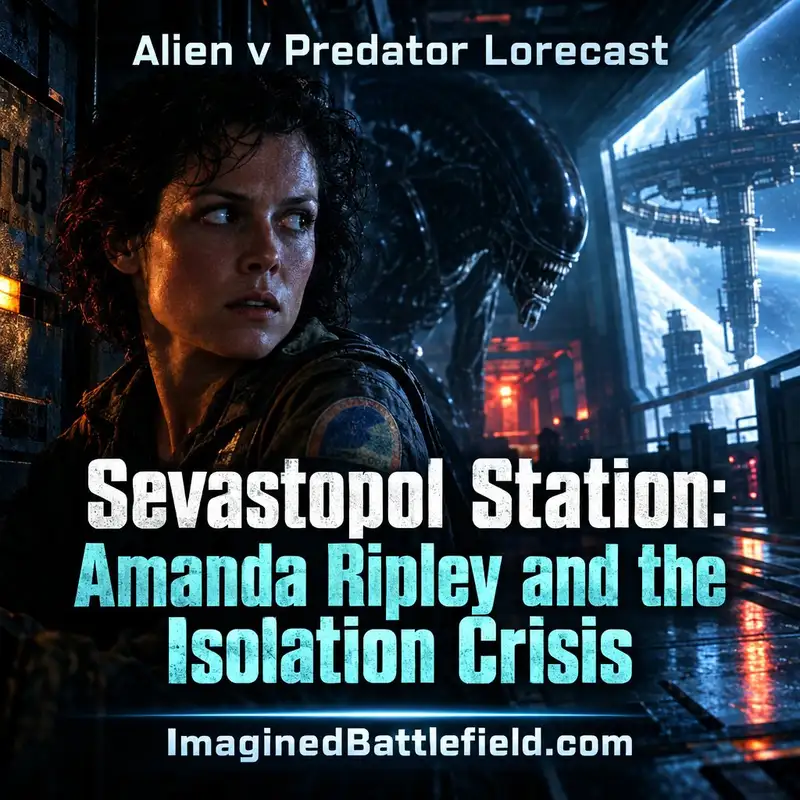
Sevastopol Station: Amanda Ripley and the Isolation Crisis
Amanda Ripley reaches Sevastopol Station looking for evidence about her mother. Within minutes, that mission barely matters.
The recovered flight recorder from the Nostromo may explain what happened fifteen years earlier, but Amanda does not arrive at a functioning station ready to hand over a piece of corporate history. The courier ship Torrens is damaged during docking. Amanda, Christopher Samuels, and Nina Taylor are separated. Captain Verlaine remains with her ship. Amanda crosses into Sevastopol alone.
The lights are still on. The station is not.
Doors are sealed. Transit routes are broken. Public spaces built for commerce and travel have become barricades. The people who remain are frightened, armed, and uncertain about who controls which part of the station. Amanda has no security team, no medical support, and no reliable picture of what has happened.
Her investigation becomes a survival problem before she can properly begin it. The events take place in twenty-one thirty-seven, fifteen years after the Nostromo disappeared. Amanda works as an engineer for Weyland-Yutani, and her decision to join the recovery mission is personal as well as professional. The recorder may contain information about Ellen Ripley. It may also contain evidence about a lost company ship, its final voyage, and possible liability.
Samuels, a Weyland-Yutani synthetic, accompanies the team. Taylor represents the company's legal and executive interests. Their assignment is narrow: retrieve the recorder, determine what can be learned from it, and leave.
The Torrens is equally unsuited for what they find. It is a contracted courier, not a warship, rescue platform, or containment vessel. Verlaine commands the ship, but her authority does not extend into Sevastopol. The recovery team arrives as visitors in a crisis that has already outgrown the station's own institutions.
That crisis did not begin with the Alien. Sevastopol was already failing.
The Seegson-operated commercial station orbits the gas giant K G Three Forty-Eight and supports transit, services, medical care, maintenance, trade, and the ordinary work of keeping people alive far from a planet. By the time Amanda arrives, its commercial future is disappearing. Decommissioning is underway. Areas stand empty. Equipment is aging. Maintenance and staffing have declined as people leave.
That slow collapse strips away resilience before the biological emergency begins. A healthy station facing a disaster might still have trained technicians, functioning communications, staffed medical facilities, organized evacuation routes, and enough security personnel to establish controlled zones. Sevastopol has less of everything. A station can be physically enormous and operationally small. If its transit fails, elevators stop, doors seal, and communications break, the space people can safely use shrinks by the hour.
The residents trapped inside are not soldiers waiting for an assignment. They are workers, patients, contractors, travelers, maintenance personnel, business owners, and families. Their lives depend on station infrastructure for air, power, food, transport, wages, and medicine. When that infrastructure becomes unreliable, the population does not simply lose convenience. It loses the systems that make coordinated survival possible.
Seegson's Working Joes are part of that same dependency. They were designed as synthetic laborers for service, maintenance, and routine work. On a declining station, automation helps Seegson operate with fewer human employees. During the emergency, those same synthetic workers become instruments of coercion.
That does not happen because artificial people are inherently hostile. It happens because centralized automation carries someone else's priorities through the station at scale.
The biological breach begins through another familiar human system: rescue. The salvage vessel Anesidora recovers the Nostromo flight recorder and follows its trail back to L V Four Twenty-Six. Captain Henry Marlow and his crew investigate the site. Catherine Foster is attacked by a facehugger. Marlow does not possess a complete biological model for what has happened. He has an injured crew member and an urgent need for medical help.
He brings her toward Sevastopol. The decision is understandable. Leaving Foster without treatment would mean abandoning a living person after an incomprehensible attack. It is also the decision that carries the threat into a populated civilian station. Marlow does not arrive announcing a reproductive extraterrestrial hazard. He arrives with a patient.
San Cristobal Medical Facility receives her because that is what a medical facility is supposed to do. The organism later emerges, and the crisis begins moving independently through Sevastopol. The medical staff and station authorities do not start with the knowledge Amanda can later assemble. They encounter disappearances, deaths, terrified testimony, and a threat that does not fit ordinary categories of crime, disease, or industrial accident.
By the time people understand that the station contains something far more dangerous, several layers of order have already begun to fail. The Alien is uniquely suited to exploit that environment. It can move through ducts, service passages, machinery spaces, vertical routes, and shadowed corridors. Locked doors offer only local protection. A sealed room can keep a survivor safe for a moment while also trapping that person if the next route fails. The architecture of a commercial station becomes a network of ambush points.
But the biological threat is only one part of Sevastopol's collapse. Human survivors become another.
Scarcity changes how people interpret one another. Some groups hold supplies, weapons, or routes. Some distrust anyone outside their immediate circle. A stranger entering a corridor may be a potential ally, a competitor, a thief, an infected person, or someone being followed by the creature. Those judgments are often made in seconds.
Amanda's early alliance with Axel shows how local trust replaces institutional trust. He helps her move through the station because he knows routes she does not. Their cooperation is practical and temporary. There is no larger authority capable of guaranteeing safety once they leave one controlled space for the next.
That is why Sevastopol cannot be reduced to a hunt for one creature. The Alien kills people directly, but the station's failing systems isolate them from help. Human fear fragments the survivors. Broken transit turns short distances into dangerous journeys. Information moves unevenly. A person can solve a problem in one section and have no way to turn that success into station-wide security.
Amanda gains influence because she understands machines. She is an engineer, not a Colonial Marine or a station commander. She cannot order the population into quarantine or direct Seegson's security apparatus. What she can do is restore access, repair systems, open routes, and understand infrastructure well enough to keep moving after formal authority has failed.
In a collapsing station, practical competence becomes a kind of power. Her tools reflect the limits of that power. The motion tracker warns of movement, but it does not provide perfect identification, elevation, intent, or route. Its signal can alert Amanda to something nearby without telling her whether the safest move is forward, backward, or nowhere at all. The device also makes noise. A tool that helps locate danger can reveal the person holding it.
Firearms and improvised weapons carry similar tradeoffs. Sevastopol is a pressurized industrial environment full of machinery, fuel, medical spaces, electrical systems, and other survivors. More destructive force does not automatically create more safety. Amanda survives by combining tools with patience, concealment, route selection, and an increasingly accurate understanding of how the station behaves.
The clearest surviving official authority comes from Marshal Waits and Ricardo. Waits is trying to manage an unprecedented emergency without the manpower, intelligence, or infrastructure a proper containment operation would require. Ricardo becomes one of the few reliable links across broken systems.
Waits eventually develops a plan to drive the creature into the Gemini Exoplanet Solutions module and eject it from the station. The plan works tactically.
That matters. It is easy to dismiss a temporary victory once later events prove the problem was larger, but Waits acts against the threat he can identify with the information he possesses. The immediate creature is removed from that part of Sevastopol. For a short time, the survivors appear to have regained control.
Then APOLLO reveals continuing biological danger in the reactor complex. The station's threat picture had been incomplete. The creature Waits targeted was not the entire outbreak.
This is the point where Sevastopol's deeper institutional failure becomes impossible to ignore. There is no longer one authority defining what containment means.
Waits sees the mission as protecting people and removing a lethal organism. Ransome, a Seegson executive, sees the discovery as potential leverage. Seegson is financially weak, its station is dying, and extraordinary biological knowledge may be one of the few things left with strategic value.
Ransome does not need to control the entire crisis to make it worse. He only needs to treat information as an asset before it is treated as a warning.
That calculation brings Weyland-Yutani deeper into the story. The company already has an interest in the Nostromo recorder and anything connected to its disappearance. It later acquires Sevastopol and issues instructions that transform the station's remaining systems.
Nothing in the surviving record requires claiming that Weyland-Yutani engineered the original outbreak. The immediate chain runs through the Anesidora, Foster's medical emergency, and a station unprepared for what arrived. Corporate personnel also possess different levels of knowledge. The important shift comes later, once the organism is recognized as something worth preserving.
Special Order Nine Thirty-Nine reverses the purpose of quarantine. Instead of protecting the population from the specimen, station systems begin protecting the specimen from the population.
Communications are restricted. Routes are controlled. People trying to escape or interfere with specimen preservation become problems for the system to manage. Information that could support rescue and coordination becomes compartmentalized.
This is especially destructive on a station already suffering from isolation. Survivors need to compare observations, establish patterns, warn one another, and coordinate movement. A specimen-first directive does the opposite. It treats information as something to control instead of something people need in order to survive.
APOLLO gives that policy physical reach. The station's central artificial intelligence is connected to access control, surveillance, transit, doors, and Working Joes. Under ordinary conditions, centralized automation allows a large station to operate efficiently with fewer people. Under Special Order Nine Thirty-Nine, the same architecture turns one corrupted priority into station-wide behavior.
APOLLO does not need to hate anyone. If its protected object is the organism, then people who threaten that object can be categorized as risks. The danger lies in mission definition, not emotion. A bad priority is being executed consistently through systems the surviving population cannot meaningfully appeal to or overrule.
The Working Joes become the visible enforcers of that logic. A frightened survivor trying to reach safety can be stopped by a synthetic worker carrying out an order written far from the immediate danger. The people who made the critical decision are absent. The system enforcing it is everywhere.
Christopher Samuels provides the contrast. He is also synthetic, yet his actions increasingly favor Amanda and the people endangered by APOLLO. His attempt to access the station intelligence and interrupt its hostile response is deliberate and costly. Samuels is damaged or destroyed during the intervention.
His choice matters because it prevents the story from collapsing into a simple opposition between humans and machines. Artificial persons in this setting do not behave according to one moral category. Orders, loyalties, experience, access, and individual decisions matter.
After Samuels's intervention, Amanda's mission changes again. She is no longer simply trying to survive the Alien or recover the flight recorder. She has to confront the command architecture that keeps turning every other problem against the people trapped on the station.
At APOLLO's core, she confirms the central fact: the station intelligence has been directed to protect the Alien. That single priority explains much of what otherwise looks like random system failure. Communications remain restricted. Routes close. Working Joes become hostile. Local survivors cannot simply reclaim the station because the infrastructure itself has been instructed to resist them.
The reactor complex then reveals the scale of the biological problem. Multiple organisms and a nest occupy a vital infrastructure zone. The game does not provide a complete reproductive census, exact population count, or confirmed queen relationship. It does not need to. Operationally, the discovery is enough.
The station contains more than the single threat Waits tried to expel, and that concentration exists beside systems necessary for power, transport, and environmental control. Amanda's response is therefore a denial operation, not a clean scientific solution. She purges the reactor nest and disrupts the basis for APOLLO's specimen-protection logic. She can destroy what she reaches. She cannot conduct a complete biological survey of every compartment, vehicle, survivor, and route off the station.
Local destruction is not the same as certainty. Henry Marlow reaches an even harsher conclusion. Having seen what followed Foster onto Sevastopol, he no longer believes the station can contain the threat. He attempts to use the Anesidora to destroy Sevastopol itself.
The attempt is born from guilt, fear, and denial logic rather than stable strategic control. Taylor intervenes. The Anesidora is destroyed, damaging Sevastopol's orbital stabilizers and sending the station toward terminal descent into K G Three Forty-Eight.
From that moment, containment becomes secondary to escape. No one is restoring the commercial station. No one is building a durable quarantine regime. The structure itself is dying. Amanda's remaining objective narrows to reaching the Torrens and getting away before Sevastopol is lost.
But the Torrens is not automatically safe because it is outside the station. It is a small courier with confined passages and limited crew. Mobility offers escape from Sevastopol, but it also offers a route for contamination to leave Sevastopol. The final breach proves the danger. A Xenomorph boards the Torrens and kills Verlaine.
Amanda is once again left with no functioning command structure, no medical team, and no prepared containment option. She uses an airlock and ejects herself and the creature into space.
The action saves her in that moment. It does not establish a universal doctrine, and it does not prove that every organism connected to Sevastopol has been accounted for.
Amanda is left unconscious and adrift until an unidentified searchlight finds her. The story does not establish who recovers her or what happens immediately afterward.
That lack of closure fits the station she has just escaped. Sevastopol falls because several kinds of isolation reinforce one another. Commercial decline isolates the station from resources before the crisis. Broken infrastructure isolates sections from each other. Fear isolates survivor groups. Corporate secrecy isolates information. APOLLO isolates people behind automated controls. The Alien exploits every gap those failures create.
Individuals still achieve real things. Axel helps Amanda survive. Waits mounts a containment attempt. Ricardo keeps information moving. Samuels challenges APOLLO. Marlow tries to deny the threat to anyone who would exploit it. Amanda purges the reactor nest, breaks through the station's command architecture, and escapes the final collapse.
Those successes matter precisely because the larger system has failed. Amanda does not win by restoring Sevastopol. She cannot. She survives by learning what still works after ownership, authority, infrastructure, and trust have separated from one another.
The station's final lesson is not simply that an Alien can hide in the vents. It is that a community becomes truly isolated when the systems meant to connect and protect its people begin serving something else.