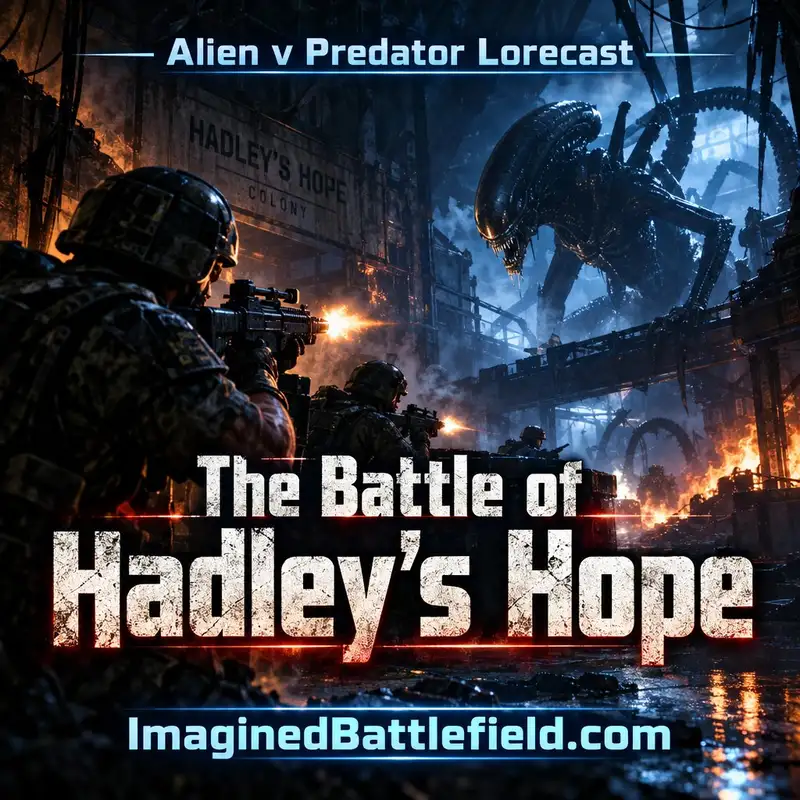
The Battle of Hadley’s Hope
At the threshold of the atmosphere processor, Lieutenant Gorman receives the information that should have changed the entire character of the mission. The missing colonists are somewhere below, inside the processing complex. The Marines are armed with pulse rifles, grenades, smartguns, flamethrowers, armored transport, and air support. Yet much of that firepower cannot be used. A burst from a rifle or the detonation of a grenade might damage the cooling systems around the reactor. The machinery that made Hadley’s Hope livable could also turn a firefight into an industrial catastrophe.
That is the essential military problem at Hadley’s Hope. The Colonial Marines do not enter a battlefield where they can apply overwhelming force without consequence. They enter a civilian industrial system whose survival depends on machinery, confined spaces, power distribution, air circulation, and cooling infrastructure. The organisms below have no comparable concern for collateral damage. They can move through darkness, walls, ducts, and maintenance spaces. The Marines must worry about every round they fire.
The Battle of Hadley’s Hope is often remembered as an encounter between heavily armed Marines and Xenomorphs. That description is true, but incomplete. The Marines did not fail because they lacked weapons. They failed because their intelligence was compromised before launch, their objective was unclear, their most useful equipment became dangerous inside the colony, and their evacuation plan depended on a small number of fragile systems. Once those systems failed, a rescue operation became a siege. Then it became an escape.
The Marine detachment is small and mobile. Gorman holds formal command, Apone provides experienced enlisted leadership, Hicks is one of the unit’s steadier noncommissioned officers, and Ripley accompanies them as a civilian adviser with the most relevant firsthand experience. Bishop provides technical capability. Burke brings corporate interests into the same operation. That mix matters because once the battle begins, rank, experience, local knowledge, and practical authority do not remain neatly aligned.
The force therefore enters Hadley’s Hope with several kinds of authority but no single person who possesses all of them. Gorman can issue orders. Ripley understands the organism. Newt understands the colony. Bishop can reach systems others cannot. The battle will repeatedly reward whichever of those forms of knowledge matches the problem of the next few minutes.
The approach to the processor offers little warning of the battle to come. Hadley’s Hope is powered but nearly empty, its rooms marked by barricades, abandonment, and signs of violence. Newt’s survival and the facehuggers found in medical containment confirm that the colony has endured something biological and sustained, not a single attack. By the time the Marines follow the colonists’ transmitters toward the atmosphere processor, they already know enough to be cautious. They do not yet know that the missing population has become the center of a mature nest.
Newt also gives the force something its sensors cannot: lived knowledge of the colony after it stopped behaving like a normal settlement. She knows that ducts and maintenance spaces can be safer than open rooms, and that the places built for human movement no longer define where danger can travel.
The medical facility removes much of the remaining ambiguity. There, the Marines find living facehuggers contained in laboratory tanks. These are not ordinary animals. They are parasitic organisms capable of incapacitating human hosts and implanting embryos. Their presence confirms that the colony has become more than a missing-persons case. A medical room, normally a place of treatment and diagnosis, has become evidence that the threat is reproductive. That changes the operational picture immediately.
Finding live facehuggers changes every assumption about rescue. A missing colonist may be wounded, dead, hiding, or implanted. Any evacuation plan now needs quarantine as much as transport. But that realization arrives just as the Marines are moving toward the place where the danger has already reached its largest scale.
The colony computer then directs the team toward the atmosphere processor. Beneath it, the Marines find the missing colonists attached to the walls of an expanding nest. The people have not become a conventional enemy force. They have become hosts. The horror of the scene has an operational consequence. The rescue mission has already failed in its original form. The missing population cannot simply be collected and transported out. The team is now facing a live infestation of unknown size, with unknown numbers of adult organisms, unknown numbers of parasites, and no reliable map of the hive.
Inside the nest, exact numbers no longer matter. The Marines cannot reliably count hosts, eggs, parasites, or adults, and their motion trackers cannot reveal elevation, intent, or safe fields of fire. The operational fact is enough: they are inside a reproductive environment of unknown size, with the missing colonists embedded in it.
This is the point at which the atmosphere processor becomes decisive. The Marines have located the center of the infestation, but they cannot use their strongest weapons freely. Gorman orders them to surrender their pulse-rifle magazines and grenades before moving deeper into the complex. Flamethrowers remain available. Smartguns are still present. Sidearms and improvised options remain. But the unit is now entering a dense, unfamiliar, contaminated environment with reduced firepower and narrow margins for error.
The order is understandable. A commander cannot knowingly allow his force to rupture a major cooling system beneath a civilian colony. Yet the order also exposes the weakness of the mission plan. No one had rehearsed a constrained assault against a concealed reproductive threat in critical industrial infrastructure. The Marines have weapons suited to open combat, but their mission has become close-range movement through a maze where every wall may conceal an organism and every uncontrolled shot may create a second disaster.
The hive ambush is not simply a case of Marines being surprised by creatures in the dark. It is a small-unit breakdown driven by terrain, uncertainty, and compression. The Marines move through restricted passages where spacing becomes difficult. Their fields of fire overlap badly. The organisms use walls, ceilings, structural recesses, and vertical space. Motion tracker contacts appear close, but the Marines cannot immediately determine where the targets are relative to them. The threat is not merely in front of the formation. It is around the formation.
Apone and Dietrich are taken alive in the confusion. Frost, Crowe, Wierzbowski, and Drake are killed as the unit loses cohesion. The precise order of individual losses matters less than the effect on the formation. The Marines lose experienced people, lose clear sectors of fire, and lose the ability to distinguish withdrawal routes from danger areas. A force trained to support one another can still be broken apart when the environment turns every movement into a close-range contact.
Gorman’s position adds another layer of difficulty. He is monitoring the action remotely from the armored personnel carrier rather than moving with the Marines inside the hive. Remote command has advantages when communications, sensors, and maps are reliable. Here, they are not. He sees fragments of the battle through helmet cameras and tracker reports. He cannot smell the atmosphere, judge the spacing, or identify the physical routes by which the creatures are attacking. When the situation becomes chaotic, the gap between formal command and the people under fire becomes dangerous.
Ripley recognizes that waiting for a perfect order will get the survivors killed. She takes control of the armored personnel carrier and drives it toward the processor to extract the Marines. This is not a formal transfer of military command. Ripley does not suddenly become a Marine officer. It is an act of practical leadership during a command failure. She has enough knowledge to understand the scale of the danger, enough resolve to act, and immediate access to the only vehicle capable of reaching the trapped personnel.
The rescue succeeds only partially. A small group gets out. The larger mission does not. The colonists cannot be recovered. The hive remains active. Gorman is injured and incapacitated during the withdrawal. Apone is gone. The detachment has lost much of its combat strength in minutes. At the tactical level, the Marines have lost initiative, cohesion, and freedom of movement. At the mission level, the search-and-rescue operation is over. The question becomes whether anyone can leave the moon alive.
Withdrawal still appears possible because the dropship is waiting at the landing area. In expeditionary operations, air mobility is not merely convenience. It is the connection between a ground force and the rest of its support system. The dropship carries personnel, provides rapid extraction, and links the team to the Sulaco in orbit. It gives the Marines the ability to disengage from a fight they can no longer win on the ground.
That capability disappears when a Xenomorph reaches the dropship and attacks the flight crew. The aircraft crashes, destroying the immediate evacuation route and killing the people needed to fly it. The loss is more than a transport accident. The Marines lose air mobility, medical evacuation, rapid reinforcement, and the simplest means of communicating with the reserve dropship. The armored personnel carrier’s transmitter is lost with the wreckage. A mission that expected to move freely between orbit and ground is suddenly fixed in place.
This is the decisive operational turning point at Hadley’s Hope. Before the crash, the Marines have suffered a disastrous ambush but still possess a path to withdrawal. After the crash, they are stranded inside a colony designed for industrial work, not prolonged defense. Their remaining ammunition is limited. Their equipment is damaged. Their command structure is compromised. Their enemy knows the terrain better than they do. And their rescue timeline is measured in days, while their ability to hold a defensive position may be measured in hours.
The survivors return to the operations center and begin doing what competent forces do after a failed contact. They consolidate personnel. They inventory weapons and ammunition. They examine maps. They reinforce doors and barricades. They study likely avenues of approach. They establish defensive positions and try to create overlapping fields of fire. Hicks emerges as the senior effective Marine. Ripley contributes the best available understanding of the organisms. Newt offers local knowledge of the colony’s ducts and passages. Bishop becomes essential to technical problem-solving.
The defensive work is not futile or foolish. It buys time. The operations center offers walls, doors, equipment, and a defensible interior. The survivors understand that isolation is dangerous, so they stay close. They understand that the organisms use hidden routes, so they study the colony plans. They understand that a direct assault may come, so they prepare weapons and barriers. In a conventional siege, these actions might establish a viable strongpoint until relief arrives.
But Hadley’s Hope is not a conventional siege. The defenders do not control the full physical system around them. The colony contains ducts, tunnels, service spaces, foundations, and structural voids. Newt knows that there are places adults do not normally use. The Xenomorphs have already demonstrated that they can move through walls and ceilings. A barricade is only as strong as the map behind it. If defenders do not know every route into their position, they are not holding a perimeter. They are holding a room.
The defenders later try to turn the operations center into a strongpoint, and the Special Edition adds sentry guns that buy additional time along selected approaches. The principle is the same in either cut. Automated fire and barricades can deny a corridor. They cannot secure routes the defenders do not know exist, and every defensive system becomes temporary once ammunition, power, or time begins to run out.
The survivors’ situation worsens when Bishop assesses the damage caused by the dropship crash. The atmosphere processor’s cooling system has been compromised. Without repair, the installation faces catastrophic failure in roughly four hours. The figures given in the film describe a destructive event with a radius of about thirty kilometers and an estimated yield of roughly forty megatons. Those are in-universe technical projections, not engineering data that can be independently verified. Their operational meaning is clear enough. Hadley’s Hope is becoming uninhabitable even if the defenders could keep the organisms outside.
The processor now plays three roles in the battle. First, it restricts weapons use during the hive assault. Second, it becomes an industrial hazard that imposes a hard deadline on the survivors. Third, it offers the only realistic means of destroying the colony and the hive together. This is why infrastructure matters in military history. A power plant, reactor, processing system, or transportation hub is never just scenery. It can be a source of life, vulnerability, coercion, and destruction at the same time.
The survivors estimate that outside rescue could take seventeen days. Their processor may fail in hours. This is frontier logistics in its harshest form. The Sulaco is in orbit, but it cannot simply solve the ground problem. The colony has no intact aircraft. The surviving force has no reliable immediate link to the reserve dropship. The nearest relief is effectively too far away. Technology has shortened some distances between worlds, but it has not eliminated the time required for a rescue force to arrive, understand the problem, and act.
The processor countdown changes the battle’s objective for the final time. Hadley’s Hope cannot be restored. The hive cannot be cleared methodically. The colonists cannot be recovered as a community. The remaining mission is evacuation without spread: get the survivors off the moon, deny the organisms a ride out, and leave before the industrial system beneath them fails.
By then, authority has shifted toward the people still solving immediate problems. Hicks provides practical military leadership. Ripley understands the threat. Bishop becomes essential to restoring an evacuation route. Newt still knows spaces the adults do not. The battle has stripped away the distinction between the original plan and the plan that can still work.
The Xenomorphs then remove another human advantage. They cut the power. Darkness is not merely an inconvenience in the operations center. It degrades observation, communication, confidence, and the defenders’ understanding of where their barriers begin and end. The Marines still have weapons and some sensors, but the loss of power turns a difficult defensive problem into a near-impossible one. The people inside the room are now waiting for an enemy that can exploit spaces they cannot see.
The breach reveals the limits of the defensive plan. The organisms do not simply force their way through the obvious barricades. They reach the survivors through routes that have not been identified or controlled. The defenders had prepared for tunnels and doors. They had not secured the full volume beneath, behind, and around their position. Hudson is killed during the collapse. Burke flees rather than remain with the group he has endangered. His attempt to save himself does not restore his control of events. He is left inside the colony he helped turn into a biological disaster site.
Gorman and Vasquez make their final stand while trying to prevent the breach from consuming the remaining survivors. Their action is local and immediate. It does not save the colony. It does not reverse the earlier ambush. It does give others a chance to keep moving. That is often what courage looks like in a collapsing operation. Not a grand victory, and not a clean solution, but a decision to hold a dangerous point long enough for someone else to reach the next door, vehicle, or evacuation route.
At this point, the battle’s purpose has changed completely. There is no longer a credible plan to secure Hadley’s Hope. There is no rescue mission left to complete. There is no legitimate specimen-recovery objective. There is only the problem of preventing the organisms from leaving with the survivors. Containment no longer means holding the colony. It means denying the colony as a route of spread and escaping before the processor fails.
Newt is taken during the retreat, and Ripley chooses to go back for her. Militarily, it is an extreme risk. The hive is still active. The processor countdown continues. The remaining survivors have little margin for delay. But the decision cannot be understood solely through operational arithmetic. Newt is not an expendable complication to a withdrawal plan. She is a child who has survived the destruction of her entire community. Leaving her behind would mean accepting the same logic that had already failed the colonists.
Ripley returns to the processor complex with weapons, a locator, and a limited amount of time. She moves through the hive not as a commander conducting a clearance operation, but as a survivor pursuing one person through an environment she knows cannot be controlled. There is no attempt to capture specimens, map the nest, or restore the facility. The purpose is recovery and escape. That narrow objective is what makes action possible.
Inside the egg chamber, Ripley encounters the queen. The existence of this queen explains the scale and reproductive capacity of the nest at Hadley’s Hope, but it should not be treated as a universal model for every Alien story or every possible organism. In this incident, the queen is central because the hive is not merely a collection of hidden adults. It is a reproductive system capable of sustaining and expanding the threat through captured hosts.
Ripley destroys the egg chamber and escapes with Newt through the processor complex. The destruction is not a clean tactical maneuver. It is an act conducted under pressure, amid fire, damaged infrastructure, and a rapidly closing evacuation window. The queen survives long enough to pursue them, demonstrating again that killing visible organisms or burning part of a nest does not automatically resolve the entire problem. The threat remains active until the survivors are physically separated from it.
Bishop provides that separation. Earlier, he had identified a difficult route to the colony’s remote communications equipment. Now, after reaching the necessary systems, he remotely pilots the reserve dropship to the landing area. His role is a reminder that technical competence can be as decisive as firepower. Bishop does not win the battle through superior violence. He creates an evacuation option when the ordinary chain of transport and command has failed.
The reserve dropship extracts Ripley, Newt, Hicks, and Bishop from the surface. They reach the Sulaco, but the danger follows them. The queen has concealed itself aboard the dropship, and the final confrontation occurs after what appears to be a successful evacuation. This is another consequence of treating the Xenomorph threat as more than a conventional enemy force. Extraction does not guarantee safety. Vehicles, cargo spaces, wounded personnel, and escape craft can become routes by which the threat survives the destruction of the original site.
The final removal of the queen from the Sulaco secures the immediate survival of the remaining group. Soon afterward, the atmosphere processor explodes. Hadley’s Hope is destroyed. The colony, the hive, the industrial infrastructure, and the evidence of the battle vanish together. The blast denies the site as a corporate asset and eliminates the active infestation on LV-426. It does not establish that the species has been eliminated elsewhere. It does not answer every question about the organism’s origin. It does not repair the lives already lost.
At the tactical level, only a handful of people survive. At the mission level, the rescue fails. The missing colonists are not saved, and most of the Marine detachment is lost. At the operational level, the expedition loses the colony but achieves evacuation after its original extraction plan collapses. At the strategic level, the destruction of Hadley’s Hope prevents Burke from turning the site into a recoverable biological resource. At the corporate level, his private recovery effort ends in failure. At the civilian level, a frontier settlement is erased after its residents were first exposed to danger, then isolated by distance, and finally consumed by secrecy.
The Battle of Hadley’s Hope is therefore not a story about superior weapons failing against a stronger creature. The Marines lose control because their firepower is constrained by industrial terrain, their intelligence is incomplete, their extraction system is fragile, and the enemy can turn casualties into part of its own reproductive system. The survivors escape only after abandoning the idea that the colony can still be held, studied, or recovered. Hadley’s Hope ends not with a clean victory, but with the destruction of the battlefield itself as the last workable form of containment.