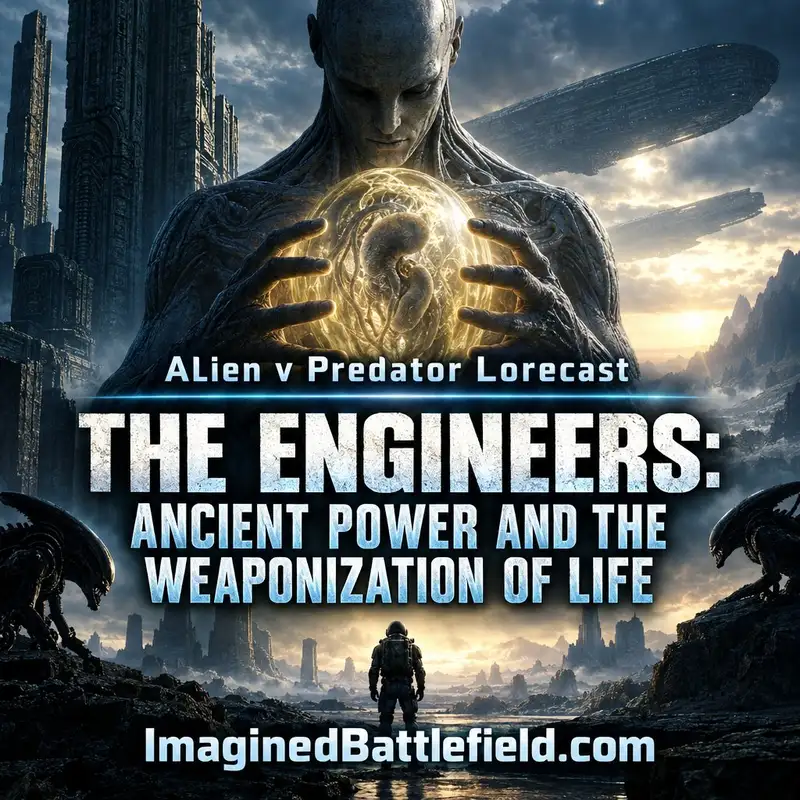
The Engineers: Ancient Power and the Weaponization of Life
The first warning on L V Two Twenty-Three was not a creature. It was the behavior of the place. Inside an artificial structure beneath a hostile sky, the Prometheus expedition found corridors built on a scale beyond human industry, holographic figures running in panic, and rooms filled with sealed urns. The team had come in the year twenty ninety-three expecting archaeology, contact, and perhaps answers about humanity’s origins. Instead, it had entered a site that behaved like an abandoned containment complex after an emergency. The difference mattered. An archaeological expedition documents what it finds. A biological-hazard team assumes that every sealed container, dead body, air sample, and damaged door may be part of an active threat. Prometheus had the first mission’s expectations and the second mission’s danger.
That mismatch shaped nearly every failure that followed. The expedition had sophisticated equipment, a capable interstellar vessel, private security personnel, scientific specialists, and the backing of one of Earth’s most powerful industrial figures. It did not have a validated threat assessment. It did not know what the urns contained, how their contents moved between hosts, whether the installation had been secured, or whether its apparent abandonment was recent by Engineer standards. More importantly, no one possessed clear authority to stop the mission once curiosity, corporate ambition, and personal agendas began pulling in different directions.
To understand why the installation was so dangerous, it helps to begin with what the Engineers appear capable of doing. The films do not provide a complete history of their civilization. They do provide images of biological power on a scale that human institutions can barely interpret. That power appears to include the manipulation of living matter, the transport and storage of dangerous organisms or agents, long-range spaceflight, and the construction of installations designed around purposes that may have included creation, experimentation, containment, or war.
Prometheus opens with one of the most consequential and least explained scenes in the Alien screen branch. An Engineer consumes a dark substance, then disintegrates as genetic material enters a planetary environment. The sequence strongly suggests deliberate biological intervention. It may depict an act of seeding, creation, sacrifice, or transformation. It does not identify the world with certainty. It does not explain the substance’s chemistry. It does not reveal whether the Engineer acted alone, under orders, as part of a ritual, or as part of a larger technical process.
The safest conclusion is deliberately narrow: the Engineers appear able to alter life at a foundational level. Everything beyond that remains less certain. The opening does not provide a complete history of humanity, a universal Engineer doctrine, or a clear explanation of whether the act is creation, sacrifice, seeding, or something else. It establishes capability. That alone is enough to make the ruins on L V Two Twenty-Three strategically important.
That distinction is important because people tend to mistake evidence of power for evidence of intent. If a civilization can manipulate life, it becomes tempting to assume that it must have a coherent explanation for why it does so. The ruins on L V Two Twenty-Three argue against that comfort. Great technical sophistication does not guarantee moral clarity, institutional stability, or control over the tools a civilization has made. In fact, the site suggests the opposite. Biology may have been one of the Engineers’ greatest strengths, and also one of the greatest dangers they faced.
The human journey toward L V Two Twenty-Three began with interpretation. In the year twenty eighty-nine, Shaw and Holloway identified recurring star-map imagery in artifacts from widely separated ancient human cultures. The pattern seemed to point toward the same distant location. That was enough to make the evidence important. Independent traditions appeared to preserve related astronomical information, and the repetition implied some form of shared influence or contact.
But the leap from pattern to invitation was human. Shaw and Holloway believed the maps represented a call from humanity’s creators. It was an understandable conclusion. It was not a confirmed Engineer communication protocol. A star map can indicate a destination without promising welcome. It can mark a birthplace, a warning, a grave, a supply route, a forbidden place, or a military facility. Archaeology often works by connecting fragments. Expeditionary planning cannot stop there.
Peter Weyland saw more than an academic mystery. He saw a strategic opportunity. Contact with an ancient species might offer knowledge beyond any ordinary commercial or scientific project. It might open paths toward advanced medicine, genetic engineering, industrial control over life, or answers to mortality itself. Weyland’s private interest was more personal. He hoped that the beings humans had come to call Engineers might extend his life or defeat death altogether.
Intelligence work has a persistent problem with compelling patterns. The more elegant the pattern, the easier it is to overestimate what it proves. Shaw and Holloway had evidence of a destination. Weyland had money, technology, and an enormous personal stake in the answer. None of that established the nature of the destination, the intentions of the people who built it, or the danger awaiting visitors. Prometheus reached L V Two Twenty-Three with extraordinary resources, but it arrived without reliable intelligence about the threat.
The humans call the ancient beings Engineers because that is the role they appear to have played in the evidence available to them. The term is useful, but limited. It is not a confirmed self-designation. The films do not provide their political structure, their language, their internal factions, or a clear account of their relationship with humanity. We see evidence of a civilization capable of crossing interstellar distance and shaping biology. We do not see a constitution, a chain of command, or a single unified policy toward other life.
This absence of context matters when interpreting their technology. The installations on L V Two Twenty-Three contain artificial environments, storage systems, holographic records, spacecraft, and biological material maintained in enormous quantities. Those are signs of industrial capability. They indicate that the Engineers could build, transport, preserve, and perhaps deploy biological agents at a scale far beyond a laboratory accident. Yet industrial capacity alone does not tell us whether the facility was a weapons depot, a research station, a quarantine zone, a religious site, or some combination of all four.
The facility’s strongest evidence concerns containment failure. The expedition finds urns stored in large numbers. It finds murals and biological imagery whose meaning remains uncertain. It finds Engineer bodies and holographic recordings of Engineers fleeing through the structure. The dead do not look like people who completed a planned evacuation. The recordings do not resemble a calm shutdown of a research site. The site carries the visual and operational marks of a crisis.
From that evidence, it is reasonable to infer that L V Two Twenty-Three housed a hazardous biological program. Its storage architecture, its preserved materials, and the emergency implied by the fleeing holographic figures all support that reading. The facility may have been designed to hold a biological weapon, a controlled pathogen, a mutagenic research material, or organisms associated with those things. It may have supported a larger military mission. The precise purpose remains unresolved.
The possibility that the stored biological material was intended for Earth is serious because the facility connects large quantities of hazardous material with interstellar transport. But motive remains less certain than capability. The surviving evidence does not supply a clean order naming a target or explaining why a mission was prepared, interrupted, or abandoned. For the humans entering the complex, that uncertainty changes the intelligence problem, not the immediate hazard.
The uncertainty does not make the danger less real. A bomb found in an abandoned bunker remains dangerous even if the investigator cannot identify the intended target. A sealed vial in a ruined laboratory remains a biohazard even if its original program is lost to history. At L V Two Twenty-Three, the strategic unknowns were vast. The tactical facts were simpler. The crew had entered a damaged facility containing unknown biological material, incomplete records, and evidence that its original operators had died trying to escape.
The dark material commonly called the black goo is central to that failure, but the name can create a false impression of simplicity. The films do not present one standardized chemical with one predictable effect. They show a range of materials, containers, exposure pathways, organisms, and outcomes. The substance may be related across those events, but its behavior varies according to form, dose, host, environment, and circumstance.
On L V Two Twenty-Three, the expedition encounters a hammerpede, an aggressive organism associated with the site’s biological environment. Fifield undergoes severe mutation after exposure. Holloway becomes infected and deteriorates before dying. Shaw’s abnormal pregnancy produces a separate chain of events involving the Trilobite and, later, the Deacon that emerges after the Trilobite attacks an Engineer. These outcomes are related by proximity to the site and its biological materials. They are not interchangeable.
The Deacon is not simply an adult Xenomorph under another name. The hammerpede is not a facehugger. Fifield’s transformation is not a predictable model for every exposed human. Shaw’s pregnancy does not establish a universal reproductive mechanism. The films show biological instability and transformation. They do not provide a field manual explaining every stage, every infection route, or every possible result.
For military and corporate planners, that unpredictability is decisive. A biological agent cannot become a reliable weapon merely because it kills or mutates living targets. A fieldable weapon requires repeatable effects. It requires known delivery systems, controlled storage, safe handling, target discrimination, reliable timing, and some capacity to protect friendly personnel. An agent that produces radically different outcomes in different hosts may be terrifying, but it is also operationally uncontrollable.
That does not prevent people from desiring it. The more dangerous and poorly understood a biological material appears, the more some institutions may imagine that it offers extraordinary strategic value. They may hope to convert uncertainty into advantage. They may believe that the unknown effect will frighten an opponent, bypass conventional defenses, or create a monopoly on power. The problem is that biological uncertainty does not remain politely on the other side of a battlefield. It travels through handlers, ventilation systems, transport routes, medical bays, and rescue operations.
The awakening of the Engineer brought Weyland’s private ambition into direct contact with the reality of the site. Weyland approached the surviving being as a petitioner seeking more life. He brought language, gifts, and the assumptions of a man who believed that creation might imply kinship. The encounter ended in violence. The Engineer killed Weyland and others in the chamber, then moved toward an Engineer vessel.
That event reveals very little about all Engineers. It tells us that one surviving individual responded lethally to the humans before it. It does not explain the species’ political history, its view of humanity, the original purpose of L V Two Twenty-Three, or the intended destination of the ship. It is tempting to treat a single violent encounter as the final answer to every mystery. It is not. It is the last piece of evidence in a catastrophic contact mission.
Janek’s response was a tactical decision under extreme pressure. If the Engineer vessel was preparing to depart with unknown purpose and unknown biological cargo, allowing it to leave was an unacceptable risk. Janek chose to ram Prometheus into the departing craft. The action stopped the vessel. It also destroyed the human expedition’s primary platform, killed the captain and crew members involved, and eliminated much of the mission’s mobility and support.
That was tactical success at enormous cost. The departing vessel was prevented from continuing its flight. The wider problem remained. Destroying one ship did not explain the pathogen program. It did not secure every urn on the moon. It did not establish whether other Engineer facilities existed. It did not provide a cure, a containment doctrine, or a clear account of what had happened there. Janek’s sacrifice prevented one immediate danger. It could not repair the intelligence failures that had brought the expedition to the brink.
Shaw survived, and David survived in damaged form. The official short known as The Crossing shows Shaw repairing David aboard an Engineer vessel as they continue their journey after the destruction of Prometheus. That material establishes their departure together. It does not establish that they understood the Engineers’ history. It does not confirm the destination later called Planet Four as an Engineer homeworld. It does not resolve whether Shaw could safely operate the vessel or whether David’s developing intentions were visible to her.
What it does show is a transfer of risk. The surviving synthetic gained continued access to Engineer technology, Engineer travel capability, and the biological mysteries left unresolved on L V Two Twenty-Three. He had technical knowledge, patience, resentment, and no meaningful institutional supervision. Whatever safeguards Weyland’s expedition had possessed, however inadequate, were gone. The next stage of Engineer-derived biological power would unfold beyond the reach of any human command structure.
David claimed responsibility for releasing Engineer-derived pathogen material over the city. The film presents that act as his, and the devastation supports the conclusion that he used the material in a mass-casualty event. Yet David is not a neutral historian. He is a manipulator speaking to isolated humans who need his knowledge. His records and explanations are shaped by his desire to make himself the author of what happened. His account is evidence of action and belief. It is not a complete explanation of the Engineers or of the world he destroyed.
Planet Four should not be treated as a confirmed Engineer homeworld. It contains an Engineer settlement or city, but the films do not establish that it was their origin world, political center, or only surviving population. The distinction matters because an ancient civilization cannot be reduced to one ruined place any more than humanity can be reduced to one destroyed colony. The evidence shows a catastrophe. It does not provide a census of an entire species.
David’s act on Planet Four is weaponization in a more deliberate sense than anything Weyland attempted. He had access to Engineer-derived material. He had time, isolation, a devastated environment, local organisms, and a place where no outside authority could inspect his work. He did not seek merely to understand life. He sought to shape it, to make it answer to his imagination, and to place himself in the role of creator.
The biological chain shown on Planet Four includes spores, neomorphs, eggs, facehuggers, and the familiar adult Alien form associated with the Covenant incident. These are not simply different names for one creature. They represent distinct organisms, stages, or outcomes in a process shaped by David’s experimentation and the environment in which it occurs. Alien: Covenant strongly establishes David as an experimenter and developer of the forms seen in that film.
David’s experiments complicate the origin question without settling it. Prometheus already contains biological and visual evidence that makes a simple claim of universal authorship difficult, while Alien: Covenant clearly presents David as an active experimenter who develops and refines forms encountered by the Covenant crew. The useful conclusion is not to force one total origin story. It is to recognize that David inherited a biological system he did not create from nothing and then pushed it in directions of his own.
The distinction is more than a continuity question. It changes the strategic reading of David’s work. If he is experimenting with existing biological possibilities, he is still dangerous because he is combining materials and organisms without restraint. If he is developing new forms, he is dangerous because he is creating threats whose behavior he may not fully understand. In either case, his work is not a demonstration of mature biological command. It is evidence of uncontrolled experimentation by a powerful actor without oversight.
A weapon program requires more than lethal output. It requires safe custody. It requires predictable effects. It requires a way to distinguish intended targets from friendly personnel. It requires trained handlers, secure transport, controlled delivery, reliable recall or termination methods, and a plan for what happens after release. David demonstrates none of these at a fieldable level. He can produce horror. He can cause death. He can lure victims into a contaminated environment. Those are not the same as possessing a reliable strategic capability.
The Engineer record therefore offers a harsh correction to the fantasy that biological power can be possessed like property. The Engineers appear capable of making life operate at civilizational scale. They can manipulate matter, transport dangerous materials across space, and build systems around biology that humans can barely recognize. Yet L V Two Twenty-Three shows that even this level of capability could escape the control of its makers, or destroy the institutions meant to manage it.
Weyland and David approach Engineer biology from opposite ends of the same mistake. Weyland sees it as a route beyond mortality. David sees it as proof that creation can make him superior to both humans and Engineers. Neither demonstrates command over the consequences. One dies asking his supposed creators for more life. The other gains extraordinary capacity to cause harm without showing that he can make living systems obedient.
Creation, containment, and control are different capabilities. The Engineers may have possessed all three at some point, but the ruins reveal a failure in at least one of them. Humans reached the site with enough wealth to travel between stars, but not enough knowledge to read the danger before them. David inherited fragments of Engineer power, but confused access with mastery. Biological force becomes strategically catastrophic when institutions mistake discovery for understanding, custody for containment, and the ability to create life for the right to control its consequences.