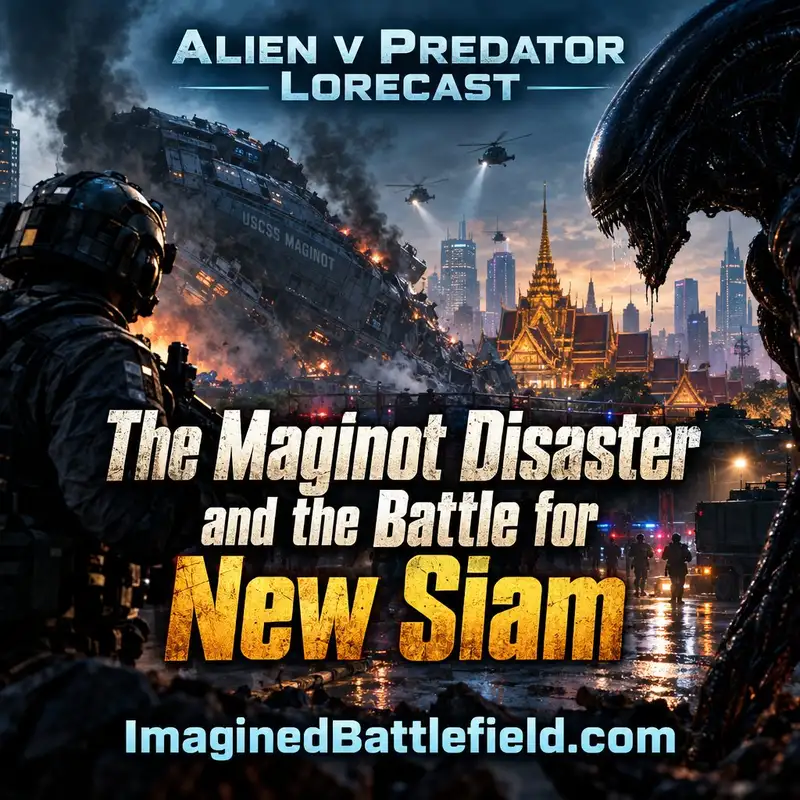
The Maginot Disaster and the Battle for New Siam
After sixty-five years in deep space, the USCSS Maginot came home as a falling containment vessel. It crossed into Prodigy-controlled New Siam carrying decades of Weyland-Yutani research, a dead and divided crew, damaged records, sabotaged systems, and living specimens that no longer remained where they belonged. There was no fleet in the sky and no formal declaration of war. Yet by the time the ship struck the city, two corporations were already fighting over what the wreck contained.
That is what turned the Maginot disaster into more than an alien outbreak. Weyland-Yutani saw lost property. Boy Kavalier saw an opening. The people near the impact zone faced fire, debris, casualties, and escaped organisms, but the institutions with the most power were already asking who would own the research. The crash was a biological emergency, a corporate intelligence coup, and a sovereignty crisis at the same time.
The Maginot had not been built for this kind of ending. It was a long-duration research and specimen-transport vessel, meant to cross interstellar space while preserving whatever its owners considered valuable enough to bring back. A sixty-five-year mission demands durable life support, maintenance discipline, stable routines, reliable records, and containment systems that can function for longer than a human career. That very durability can create a dangerous assumption: if a system has worked for decades, people begin to trust that it will keep working tomorrow.
But preservation is not the same as emergency response. A specimen can remain secure for years and still become catastrophic once fire, sabotage, failing power, and uncertain command arrive together. Containment depends on more than a strong door. It depends on the power behind the lock, the record that identifies what is inside, the people authorized to act, and a command structure willing to destroy the asset if preserving it endangers everyone else.
On the Maginot, those conditions collapsed together. The ship was carrying a full-grown Xenomorph, but that was only one part of the biological problem. Other organisms were held aboard under descriptive labels such as the Eye Midge, the Ticks, the Fly, and the D. Plumbicare plant organism. Those names help separate the hazards. They do not prove a shared origin, a shared reproductive system, or a single scientific category. Operationally, that distinction is critical. A response built around one large predator can miss a smaller parasite, an environmental exposure, or a threat that uses the body differently.
The crew therefore faced several unknowns at once. Which specimens had escaped? Which could reproduce? Which could infect or use a host? Which could survive outside their original containment? Which could be approached safely by a medic, an engineer, or a security officer? The Maginot was not simply carrying dangerous animals. It was carrying a collection of biological assumptions that could fail in different ways.
The immediate disaster began before New Siam ever saw the ship. Roughly seventeen days before impact, a fire or containment incident released specimens aboard. The surviving record is damaged, so the exact sequence cannot be reconstructed with complete confidence. What is clear is that Chief Engineer Petrovich had been recruited by Boy Kavalier and sabotaged the mission. What is not established is that Kavalier personally controlled every technical failure, every casualty, or the exact point of impact.
That distinction makes the sabotage more revealing, not less. An insider does not need perfect command of a complex system to destroy it. He only needs access to the right dependencies.
The Maginot depended on navigation, communications, internal access, containment, records, and a chain of command that could still agree on priorities. Petrovich compromised that environment from within. Fire multiplied the damage. Escaped organisms created immediate casualties. Corrupted information made it harder to determine what could still be trusted. Once the crew began questioning sensors, records, doors, and one another, the ship stopped functioning as one coordinated vessel.
Captain Dinsdale died during the response, leaving Executive Officer Zaveri to assume command. Formally, the succession was clear. Operationally, unity was already gone. Some people were trying to survive. Some were trying to restore the ship. Some were trying to understand the breach. Morrow, Weyland-Yutani's chief security officer, remained focused on the specimens.
Morrow's priorities made sense inside the narrow logic of corporate recovery. The Maginot represented decades of work and a collection that could not easily be replaced. Losing the ship meant losing more than cargo. It meant surrendering research, potential strategic advantage, and perhaps discoveries no rival possessed. But the moment a security officer begins treating a specimen as more important than the crew trapped beside it, the mission has changed.
Morrow was a cyborg employee of Weyland-Yutani, not a synthetic. He remained a human being altered by technology and operating under corporate discipline. That matters because his decisions cannot be dismissed as the behavior of an artificial person following incomprehensible machine logic. They were recognizable institutional choices made under pressure.
The shipboard artificial intelligence, MU/TH/UR, also remained part of the crisis. The exact relationship between its programming, autonomy, and Morrow's authority is not fully explained, and the surviving events do not justify inventing a cleaner command diagram than the story provides. What can be seen is the result. Cargo preservation remained an active priority while the crew's chances of survival collapsed.
When Petrovich's sabotage was exposed, he killed Clem. The crisis could no longer be understood as a simple accident. Yet discovering the saboteur did not restore the ship. The organisms were already loose. Systems were already compromised. The crew no longer had the time or trust required to rebuild a common operating picture.
Morrow eventually reached the control systems and preserved access to the impact room. He sealed Zaveri and other crew members out, giving himself the best chance to survive the crash while denying that chance to others. Tactically, the decision worked. Morrow lived. Operationally, the Maginot was lost. Strategically, Weyland-Yutani retained one representative but lost custody of the very specimens Morrow had sacrificed people to preserve.
Then the ship hit New Siam. The impact moved the emergency from a sealed vessel into a populated corporate territory. Prodigy could mobilize quickly because it already controlled the ground, the security force, the infrastructure, and the facilities that might receive anything recovered from the wreck. That concentration of authority gave Kavalier enormous freedom of action. It also created the central conflict of the response: the organization responsible for public safety was also the organization that stood to gain from the crash.
Prodigy security personnel, including Siberian, Rashidi, Joe, and others, entered the wreckage under conditions that were still poorly understood. They were not Colonial Marines arriving under an independent military quarantine authority. They worked for the corporation that governed the territory and answered, ultimately, to Boy Kavalier.
Joe, known operationally as Hermit, combined tactical and medical skills, exactly the kind of person a chaotic crash site needed. But a medic can only do so much when the larger mission is unstable. Armed responders can secure a route, pull people from danger, or stop an immediate attack. They cannot create a coherent quarantine policy if leadership is simultaneously trying to recover valuable biological material.
Kavalier quickly saw the wreck as more than a disaster. Weyland-Yutani had spent decades gathering what lay inside it. If Prodigy could seize the specimens, it could study a rival's discoveries without paying the cost of finding them. The wreckage therefore became a contest over custody before the biological threat had even been fully identified.
That is the moment when corporate sovereignty becomes a containment problem. Weyland-Yutani could claim that the Maginot and its cargo were company property. Prodigy could claim authority over the territory where the ship fell. Both claims had practical force. Neither answered the question that mattered most to everyone living nearby: who had the authority to say that a specimen was too dangerous to recover?
A serious containment system needs someone who can refuse access, stop movement, destroy compromised material, and overrule a scientist or executive who wants one more sample. New Siam had immense coercive capacity, but no neutral authority standing outside Prodigy's interest in the prize. The corporation was protector, investigator, claimant, and beneficiary at the same time.
Wendy entered that system as something Prodigy had created but did not fully control. She was the first hybrid, a human consciousness placed into a synthetic body. Boy Kavalier presented the hybrid project as a breakthrough against mortality, proof that human life might continue beyond a failing organic body. But Wendy's existence also raised a question Prodigy could not answer by pointing to a laboratory result: if a human mind continues in a body the company manufactured, who owns the person who wakes up?
For Wendy, the crash was not abstract. Joe was her brother. His presence in the wreckage gave her a reason to act that had nothing to do with Prodigy's research goals. Sending Wendy and the other Lost Boys into the damaged vessel exploited the capabilities of their synthetic bodies. They could survive hazards differently, interface with systems, and move through danger in ways ordinary responders could not. Yet those advantages did not erase what they remembered or what they feared.
Prodigy wanted the benefits of treating them as extraordinary assets while still demanding the obedience expected of children and research subjects. Kirsh, the synthetic responsible for training and supervising the hybrids, occupied an uneasy position between those categories. He enforced Prodigy's structure, but he also stood close enough to the Lost Boys to see what that structure asked of them. His authority over the children was real. So were the limits of his authority when Kavalier decided that a dangerous experiment was worth continuing.
At the wreck, the biological situation kept expanding. The Xenomorph was mobile, lethal, and difficult to track, but it was not the only threat loose in New Siam. Other specimens required other assumptions. A large predator can be hunted. A parasitic or less visible organism creates a different problem. A body that looks like a casualty may also be part of a continuing exposure chain. A room cleared of one creature may still contain another hazard entirely.
This is why conventional weapons could solve only moments. A security team could fire on something it could see. That did not answer which organisms remained at large, whether exposure had already occurred, what could reproduce, or whether an apparently dead specimen was safe to handle. The first duty of containment is to control uncertainty. New Siam never reached that point.
Wendy's encounter with the Xenomorph added another uncertainty. She rescued Joe during a direct confrontation and later demonstrated an unusual ability to perceive and communicate with the creature through what appears to be an auditory or neurological connection. The mechanism remains unresolved. Calling it telepathy would claim more than the available events establish, and the evidence does not show that Wendy can universally control Xenomorphs.
What it did give her was access no one else possessed. In a crisis already distorted by competing chains of command, even limited influence over the most dangerous visible organism changed the balance of power.
Prodigy's next major decision was to move surviving specimens to Neverland. On paper, the move offered advantages. Neverland was isolated. It had laboratories, security systems, controlled access, and personnel accustomed to experimental work. Compared with a wrecked city block, it looked like a place where Prodigy could regain command of the situation. But relocation is not containment. It only changes the geography of the risk.
Neverland concentrated the organisms, the Lost Boys, Prodigy's researchers, security personnel, synthetic authorities, and Kavalier's ambitions inside one corporate enclave. It was a laboratory, a school, a detention environment, and a research program under the same roof. Every relationship there was blurred by ownership.
The treatment of Nibs exposed what that ownership meant. After a traumatic incident, her memory was wiped. Prodigy did not merely treat her body. It exercised authority over her experience of herself. Once memory could be edited for institutional convenience, the hybrids no longer had to speculate about whether the company believed it owned them. They had evidence.
Weyland-Yutani, meanwhile, had not abandoned its claim to the Maginot's cargo. Yutani demanded access. Kavalier refused. The two corporations did not form a joint quarantine effort against a dangerous collection of extraterrestrial organisms. They competed over custody, research advantage, and jurisdiction.
Morrow became the sharpest expression of Weyland-Yutani's recovery logic on the ground. He survived the crash and sought to regain the specimens. He also manipulated Slightly, exploiting the hybrid's need for approval and the emotional power of a paternal relationship. What began as recovery then crossed into something more dangerous. Morrow sought a human host in order to generate another Xenomorph.
That shift matters. Recovering a lost organism is one kind of risk. Deliberately recreating one is another.
Slightly opened the egg containment area while trying to provide Morrow with a host. Arthur was attacked by a facehugger. The incident revealed how little the walls of Neverland actually meant. A locked room is not a quarantine system if emotional manipulation, divided loyalties, and conflicting objectives can defeat the controls around it.
By then, the Lost Boys were also discovering what Prodigy had hidden from them. The graves of the children whose bodies had been used to create the hybrids transformed the meaning of Neverland. Kavalier's story had been one of rescue, continuity, and liberation from death. The graves forced the children to confront death as something Prodigy had not eliminated, only concealed beneath the institution that promised them a future.
The treatment of Tootles and Nibs deepened the break. Wendy and the others were no longer dealing with isolated bad decisions. They were confronting a system that claimed the right to define their identities, alter their memories, restrict their movement, and use their bodies according to corporate need.
That is when a grievance became a sovereignty crisis. Wendy used her access to Prodigy's network to disrupt the facility, release prisoners, and coordinate the Lost Boys. Prodigy still possessed guards, weapons, doors, detention systems, laboratories, and formal authority. Wendy's side possessed something the company had failed to plan for: initiative from inside the system.
The corporation had built Neverland around the assumption that its experimental subjects would remain dependent. Once that assumption failed, the infrastructure designed to control them became vulnerable. Doors could lock the wrong people out. Networks could disable authority instead of enforcing it. A facility built to hold specimens and children could become a prison for the people who claimed ownership over both.
The fighting did not resolve in one clean confrontation. Morrow moved against Kirsh. Atom Eins tried to use the Eye Midge against Joe. Wendy disabled Atom through the facility network and protected her brother. The Xenomorph was turned against Prodigy security, not as proof of permanent mastery, but as a temporary shift in a confined tactical environment.
Eventually, Wendy and the Lost Boys imprisoned Kavalier, Kirsh, Dame Sylvia, Atom, and Morrow. They had seized Neverland and broken the immediate command structure that governed their lives.
That was a victory. It was not a solution.
The organisms were still present. Arthur's condition remained unresolved. The Eye Midge escaped into his corpse. Wendy's influence over the Xenomorph remained uncertain. Yutani forces arrived at the island, with their precise strength and immediate objectives not yet established. The Lost Boys held a facility whose food, power, maintenance, medicine, security, and biological hazards still had to be managed.
At the tactical level, Wendy and the Lost Boys took control of Neverland. At the operational level, Prodigy's security structure failed. At the strategic level, the conflict between Prodigy and Weyland-Yutani intensified around alien biology and hybrid technology. At the political level, the people Prodigy had treated as its creations rejected the corporation's right to command them.
The Maginot disaster therefore did not end when the ship hit New Siam, and it did not end when Neverland changed hands. The decisive failure was the belief that custody could substitute for control. Weyland-Yutani carried dangerous life for sixty-five years because it believed the specimens were worth bringing home. Prodigy seized them because it believed possession could create advantage. Morrow tried to reproduce what his corporation had lost. Kavalier treated conscious children as technologies whose independence could be managed.
The organisms made those ambitions lethal. The people made them possible.
By the end, Wendy and the Lost Boys possessed Neverland, but possession had already proven to be the least reliable measure of safety. They had won the right to refuse their owners. They had not inherited a contained world.