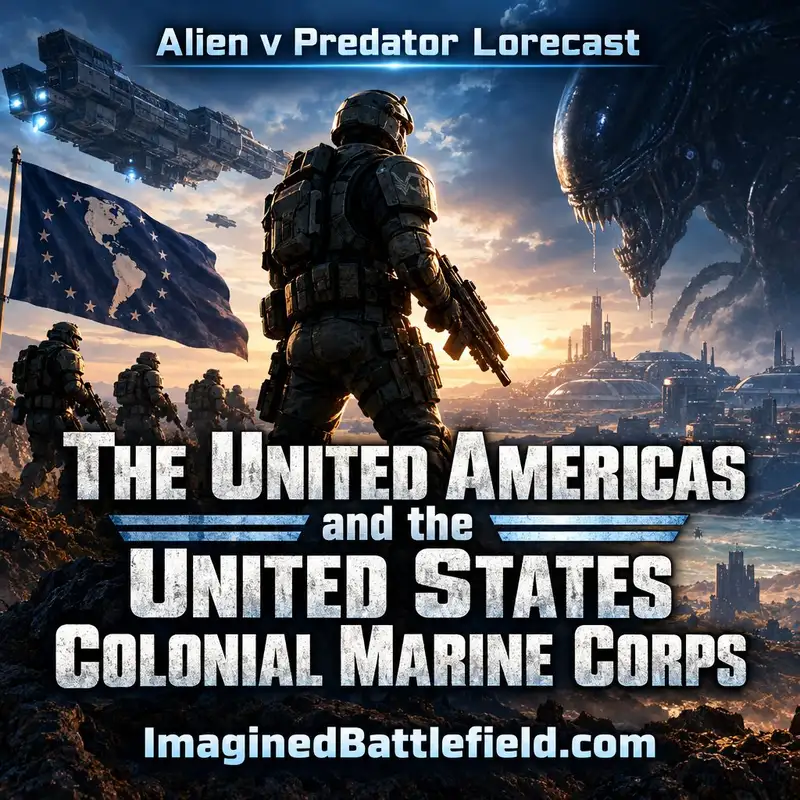
The United Americas and the United States Colonial Marine Corps
The Marine deployment to L V Four Twenty-Six arrived with the visible tools of state power. It had a military transport, a dropship, an armored vehicle, weapons, sensors, trained personnel, and a chain of command. What it did not have was an accurate account of the emergency. Contact with Hadley’s Hope had been lost. The colony’s civilians could not report what had happened. The settlement’s industrial systems had become hazards as much as assets. And a Weyland-Yutani representative was present in the operation with information and motives that were not fully shared with the people expected to enter the colony.
That failure is often remembered as a disaster for one Marine unit. It was more than that. It was a compact demonstration of the frontier problem that shapes the United Americas and the United States Colonial Marine Corps in the licensed Alien role-playing setting. A government can claim distant territory, issue contracts, establish colonial administrations, and place flags on maps. But authority means very little when a settlement loses contact, relief is far away, the local economy is privately controlled, and the first force sent to restore order does not know what it is walking into.
The Marines on L V Four Twenty-Six were not defeated because they lacked courage, weapons, or discipline. They were sent into a crisis whose actual nature had been concealed by institutional failure. Their mission began as an investigation and a possible rescue. It became a biological containment emergency inside a damaged industrial settlement. Then it became a shrinking survival operation. The lesson is not that expeditionary forces are useless. It is that no force, however capable, can compensate indefinitely for false intelligence, divided responsibility, and civilians who have already been placed at risk by someone else’s private decision.
The United Americas described in the Alien role-playing game gives that frontier problem a political framework. Its history and institutions belong to the licensed game setting, not directly to the screen continuity of Alien or Aliens. The films establish the United States Colonial Marine Corps and show one of its deployments. The role-playing setting expands that into a frontier geography, a government, and a set of institutions meant to explain how human authority works across colonial space.
In that setting, the United Americas emerged in the year twenty-one oh four. It united nations from North, Central, and South America under the Washington Treaty. This was not presented as the disappearance of every national identity, military tradition, or regional interest. It was a political union built from member states, signatories, and overlapping institutions. The United Americas had a president, a vice president, and a congress, but its power rested on more than constitutional language. It rested on trade, transport, scientific capacity, colonial development, military force, and the ability to make decisions matter far beyond Earth.
That last requirement was the difficult one. A terrestrial government can maintain authority through courts, police, roads, communications networks, emergency services, and nearby military forces. A colonial government faces a different environment. Its settlements may be separated by immense distances. Their people may depend on a narrow range of supplies, specialized machinery, corporate employers, and irregular transport. A failure in air processing, medicine, power generation, docking control, or communications can become a political emergency before anyone fires a weapon.
The frontier also creates a problem of visibility. A distant colony may legally belong to a government while functionally depending on the corporation that built its housing, operates its machinery, owns its transport contracts, and employs much of its population. The public authority may be responsible for order, safety, and law. The private authority may control the practical means by which people eat, breathe, work, travel, and receive medical care. That division is manageable in calm conditions. It becomes dangerous during a crisis.
The United Americas therefore needs more than diplomats, administrators, and commercial agreements. It needs organizations capable of moving people, equipment, authority, and emergency capability across interstellar distance. In the role-playing setting, Colonial Administration provides part of that structure. It supports and monitors colonies and stations. It helps preserve public order, maintain supply systems, and connect distant settlements to the wider political system. It can distribute necessities and gather reports. It can represent the civilian face of government.
But Colonial Administration cannot necessarily resolve an armed confrontation, a hostage crisis, a station disaster, a breakdown in public order, or the appearance of a hostile extraterrestrial organism. It may not possess the transport, security, medical capacity, engineering support, or legal authority required for a rapidly escalating emergency. A colonial official can request assistance. That official cannot always create it. The farther the colony is from major population centers, the more important it becomes that a responding force arrive able to operate without immediate reinforcement.
This is where the United States Colonial Marine Corps enters the picture. In the role-playing setting, the Corps existed before the formation of the United Americas. It brought with it the scientific, industrial, military, and expeditionary inheritance of the old United States. After the merger, that legacy helped make it the principal American force for colonial intervention and frontier security. It did not become the only armed institution in the United Americas. It became one of the most important instruments through which the union could act beyond Earth.
The Corps operates within the United Americas Allied Command, often shortened to U A A C. This joint command coordinates the military forces of the union. Its component organizations include the United States Colonial Marine Corps, the Canadian Colonial Armed Forces, the Latin American Colonial Navy, the United States Aerospace Force, and the United Americas Outer Rim Defense Fleet. The names matter because they reveal a political compromise. The United Americas is a union, not a single culture in uniform. Its military power is coordinated, but not completely homogenized.
Joint command offers obvious advantages. It can bring different services and regional capabilities into a common strategic framework. It can combine naval movement, aerospace support, garrison forces, expeditionary troops, and frontier defense. It can distribute burdens that no single member state wants to carry alone. It can also make political authority more credible. A colony in distress is not merely being visited by a local contractor or a private security team. It is receiving a response under the banner of a larger interstellar government.
Joint command also creates friction. Different organizations retain their identities, priorities, traditions, and chains of responsibility. A fleet commander, colonial administrator, Marine officer, aerospace pilot, and corporate site manager may all see the same emergency through different lenses. One may prioritize civilian evacuation. Another may prioritize infrastructure. Another may worry about legal authority. Another may want intelligence preserved. Another may simply need to keep a damaged facility from taking everyone nearby with it.
None of this makes the United Americas uniquely dysfunctional. It makes the system believable. Large political structures rarely fail because they have no organization at all. They fail because several organizations are operating at once, each with its own authority, information, and priorities. The central question is whether they can establish a common picture before the crisis outruns them. On a distant frontier, delay is often the decisive fact.
The United States Colonial Marine Corps is built to reduce that delay. In the role-playing setting, it spearheads military campaigns, maintains bases and garrisons, operates frigates and troop transports, and deploys independently into hostile environments. That means the Corps is not simply infantry with futuristic rifles. It is an expeditionary institution. It needs ships, transports, pilots, maintenance personnel, medical capacity, communications, command staff, supply systems, and a means of getting people home if the mission changes.
That broader role explains why the Corps has such a varied mission set. It can fight armed opponents. It can respond to terrorism and hostage crises. It can reinforce endangered settlements. It can provide disaster relief. It can protect civilians. It can guard infrastructure. It can conduct security operations where local authority has failed or lacks the capability to act. It can also respond to hostile lifeforms, a category that sounds simple until one remembers how radically different an animal attack, an unknown ecosystem, a pathogen exposure, and a Xenomorph outbreak can be.
On a sparsely governed frontier, these missions overlap. A mining accident can become a public-order crisis if air, food, or transport is disrupted. A labor dispute can become a security problem if a colony has no trusted civil authority. A sabotage incident can become a disaster response mission if critical machinery is damaged. A medical emergency can become a political emergency if a company attempts to conceal it. The same Marines who may be called to deter armed violence can find themselves escorting civilians, securing a landing area, restoring communications, or protecting a medical quarantine.
That flexibility is one reason the Corps matters to the United Americas. A garrison does more than wait for war. It makes government tangible. It reassures some colonists, intimidates others, provides a visible emergency reserve, and reminds private interests that colonial life is not meant to exist entirely beyond public oversight. The Corps can carry supplies, evacuate wounded people, reinforce a damaged station, and respond when local security has been overwhelmed. In a region where help may take a long time to arrive, that capacity has real political value.
Yet a force built for flexibility can also be asked to do too much. A Marine unit is not a substitute for competent governance. It cannot repair a poisoned relationship between colonists and administrators. It cannot make a corporation honest. It cannot create medical infrastructure after an outbreak has begun. It cannot restore families already lost in a communications blackout. And it cannot conduct a successful rescue if the people who know the most about the danger have chosen not to tell it the truth.
The United Americas depends heavily on colonial infrastructure that it does not always directly own or operate. Corporations can control construction contracts, terraforming systems, laboratories, housing, ships, supply chains, employment, and access to specialized equipment. They may possess expertise that governments need. They may also possess records that governments do not have. This gives corporate institutions substantial practical power even when they do not hold formal military command.
Weyland-Yutani is especially important because it appears repeatedly in the Alien setting as a corporation with broad commercial, colonial, scientific, and research interests. But it is important to be precise. Weyland-Yutani does not formally command the United States Colonial Marine Corps in the screen account of Aliens. A company representative may influence a mission. The corporation may own crucial infrastructure. It may control access to information. It may have political leverage and contractual rights. None of that makes a Marine officer into a corporate employee.
The distinction between formal authority and practical influence is central to understanding colonial security. A government may have the legal duty to protect a settlement. A corporation may have the economic stake in preserving its equipment, research, assets, and reputation. A Marine commander may control the troops. A corporate representative may know why the emergency exists. If those interests are aligned, the arrangement can work. If they are not, the military may be used to protect a private objective that has been concealed inside a public mission.
Colonial civilians bear the risk of that arrangement. They are not just names on a personnel roster or background figures in an evacuation scene. They are workers, families, administrators, technicians, children, patients, and people under contract. Their lives may depend on a company for housing and wages, on Colonial Administration for public support, and on distant military forces for security. In a well-run system, those overlapping institutions provide resilience. In a badly run system, each assumes someone else is responsible.
The corporation may say the government controls security. The government may say the company owns the facility. The company may say its information is proprietary. The military may say it requires a formal request or reliable intelligence. By the time those questions are resolved, the colony may already be in danger. This is why civilian protection is the true measure of frontier legitimacy. A government that can defend equipment but cannot protect the people dependent on it has not solved the colonial problem. It has merely guarded the investment.
Hadley’s Hope provides the clearest screen example of this tension. In the theatrical version of Aliens, contact is lost with the colony on L V Four Twenty-Six. Ellen Ripley, the survivor of the Nostromo incident, is brought into the response because she has encountered the organism before. A military team is sent to investigate. Weyland-Yutani has a substantial stake in the colony and its terraforming operation. Carter Burke accompanies the mission as the company’s representative.
The formal chain of command is not ambiguous. Lieutenant Gorman commands the Marine deployment. Burke is not the military commander. Ripley is not a commissioned officer. She is a civilian survivor and adviser whose knowledge of the threat is unmatched by anyone else on the mission. The problem is not that the legal hierarchy disappears. The problem is that the hierarchy enters the crisis with unevenly distributed knowledge.
Ripley understands that the previous encounter involved a hostile extraterrestrial organism with a parasitic reproductive cycle. She knows that the danger cannot be treated as a routine animal attack. Burke knows enough about the colony’s connection to the earlier discovery to have a powerful interest in controlling how the situation is understood. The Marines know they are being sent to investigate a loss of contact. They do not begin with a complete picture of the organism, the colony’s fate, or the possibility that the company’s actions helped create the emergency.
That difference in knowledge changes everything. A Marine unit can plan around an armed hostile force if it knows the force exists, its approximate location, its weapons, and the civilians caught in the middle. It can plan around an industrial accident if it understands the hazards and the status of life support. It can plan around a contagious disease if it knows what exposure looks like and how long observation must continue. The team at Hadley’s Hope does not receive that kind of clarity.
The problem becomes harder because a Xenomorph outbreak is not an ordinary enemy-force engagement. A conventional opponent has units, weapons, supply lines, and some recognizable command structure. A Xenomorph threat may involve hidden hosts, uncertain incubation, unseen movement routes, acid damage, reproductive expansion, and the possibility that every casualty carries consequences beyond the immediate fight. The Marine problem is therefore larger than winning a firefight. It is protecting survivors, understanding the scale of the outbreak, preventing further spread, and preserving a way out.
This is where the difference between formal command and practical authority becomes most visible. Lieutenant Gorman holds the official command position. Under normal conditions, that role gives him responsibility for directing the unit, controlling the mission, and coordinating decisions. But rank alone does not produce usable leadership when communications are failing, the plan has collapsed, and the commander lacks a clear grasp of the threat.
Hicks becomes important because he retains the trust of the Marines and can translate immediate danger into practical action. He does not become a new institution. He becomes a necessary source of steadiness when the formal command system is under strain. Ripley becomes indispensable because she has direct experience with the organism and understands risks that others have not yet learned. Her influence grows not because civilian status automatically outranks military rank, but because information matters. In a crisis, the person who understands the danger can shape decisions even without holding the highest title.
Burke’s position reveals the opposite problem. He has no formal authority over the Marines, yet his corporate role gives him access, influence, and a stake in the outcome. That is the structural danger of corporate involvement in security operations. The corporation does not need to issue orders directly if it can shape the intelligence, define the investment at risk, influence the mission’s assumptions, and place its representative close to decision-makers. Civilian control of the military is not the same thing as corporate control. Confusing the two hides the real mechanism of influence.
The United Americas setting makes this tension broader than one company representative and one damaged colony. Across the frontier, public security and private infrastructure are often intertwined. The Corps may be called to defend a station whose owners have failed to maintain it. It may be sent to calm a dispute caused by exploitative labor conditions. It may protect civilians whose only means of escape is a corporate transport. It may be asked to secure a laboratory whose research program was hidden from the surrounding community.
In every case, the Corps faces a question that cannot be answered by weapons alone. What, exactly, is the mission? Is it protecting people, restoring lawful order, safeguarding infrastructure, preserving evidence, recovering property, preventing panic, denying a hostile force access, or serving a corporate objective that has not been admitted openly? Those goals can overlap. They can also conflict. A unit cannot resolve the conflict properly if it is told only one part of the truth.
The role-playing setting places the United Americas in a tense period by the year twenty-one eighty-three. Hadley’s Hope has been destroyed. The Sulaco has disappeared. Events connected with Fiorina Fury One Six One have added to distrust and uncertainty. In that setting, suspicion toward Weyland-Yutani has intensified. There are theories about corporate bioweapons interests, secret programs, and the real causes of colonial disasters.
Those theories must be treated carefully. They are part of the licensed role-playing setting’s political atmosphere. They are not automatically confirmed facts from the Alien screen branch. What matters for this episode is not whether every rumor is true. What matters is what persistent secrecy does to a frontier security system. When serious incidents are hidden, classified, fragmented, or publicly denied, organizations lose the ability to learn from them.
A military force cannot prepare properly for hazards it is not allowed to name. Colonial administrators cannot establish meaningful safety procedures if records are withheld. Medical personnel cannot recognize exposure if previous cases are treated as proprietary research. Civilians cannot make informed choices if they are told that the danger does not exist. Secrecy may protect a corporation from liability in the short term. It may protect a government from embarrassment. But it also turns the next response force into another experiment.
This is the deeper significance of the United States Colonial Marine Corps. The Corps is not simply the armed edge of United Americas power. It is the institution expected to turn distant promises into physical presence when a frontier community is in immediate danger. Garrisons, transports, disaster response, armed intervention, evacuation, and the simple act of arriving all give that promise substance. The Corps can close distance. It cannot erase the political and intelligence failures that occurred before it arrived.
L V Four Twenty-Six shows the consequence when that larger system fails. An expeditionary force arrives armed, disciplined, and legally empowered to act, but only after civilians have already been sacrificed to concealed knowledge and private ambition. The Marines’ greatest disadvantage is not the creature’s claws, acid, or numbers. It is that the mission begins with divided responsibility, incomplete intelligence, and a human community treated as less important than the secret buried beneath it.