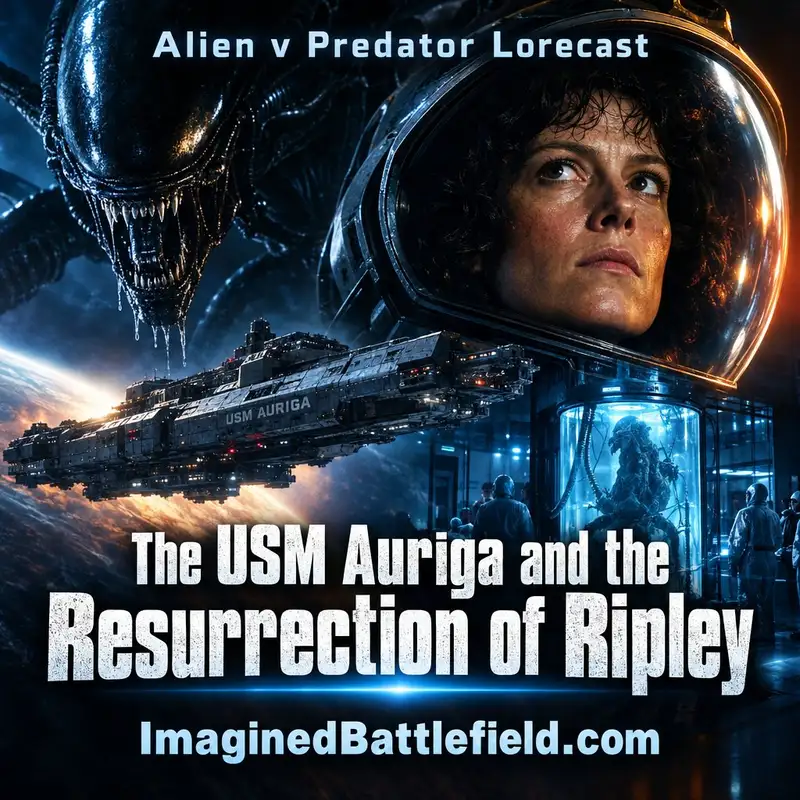
The USM Auriga and the Resurrection of Ripley
The decisive discovery aboard the United Systems Military vessel Auriga is not another escaped organism. It is the ship's destination.
The laboratory vessel has suffered a containment failure. Personnel are dead or scattered, the research compartments have become hunting ground and nursery, and the surviving humans are trying to reach the Betty before the situation collapses completely. Then they learn that the Auriga's emergency procedures are carrying the ship toward Earth.
Escape is no longer enough. If the survivors simply abandon the vessel, the organisms, the research program, and whatever biological material remains aboard will continue toward a populated world. The Auriga has become a delivery system. A military experiment that was supposed to turn alien biology into capability is now transporting that biology toward the place where its failure could matter most.
The crisis begins two centuries earlier, on Fiorina Fury One Six One. Ellen Ripley dies there while denying Weyland-Yutani access to the Queen embryo inside her. Her death is an act of containment through denial. She understands that the organism is not merely a medical emergency. It is something an institution may try to recover, preserve, and exploit. By destroying herself, she destroys the immediate recovery opportunity.
The decision is final for Ripley. It is not final for the idea of recovering what she carried.
Two centuries later, United Systems Military scientists obtain genetic material associated with her and attempt to reconstruct the loss. Their project does not exist merely to bring a dead woman back to life. The goal is more useful and more dangerous. If the military can produce a viable clone and recover the Queen embryo carried within it, then it may gain access to an organism with possible scientific, medical, industrial, and military value.
Doctor Mason Wren speaks in that language of usefulness. The Xenomorph is not treated only as a monster. It is a research platform, a possible source of materials, vaccines, and military capability. The Auriga exists because somebody believes that enough science, security, secrecy, and disposable human life can transform catastrophe into an asset.
That belief is not irrational in the narrow bureaucratic sense. A creature with extraordinary resilience, unusual chemistry, powerful defenses, and rapid adaptation would attract serious research interest. The mistake is deeper. The program treats the organism's resistance to control as a technical difficulty to be solved instead of the central warning about what it is trying to possess.
The film does not establish that the United Systems Military inherited a perfect archive of every earlier Alien encounter or a seamless institutional memory from Weyland-Yutani. The Auriga is a later program with its own scientists, officers, systems, and incentives. That matters because the same mistake has reappeared in a different institution.
Possession is still being mistaken for control.
The first seven cloning attempts demonstrate how uncertain the project really is. They do not restore Ellen Ripley. They produce failed reconstructions, bodies that show the difficulty of separating human genetic material from the Xenomorph biology the scientists are trying to recover. The eighth attempt is the first viable success.
Ripley Eight survives. She can speak, move, remember fragments, make decisions, and display abilities the project did not fully predict. The Queen embryo can be extracted from her. From the laboratory's perspective, this is the breakthrough.
But Ripley Eight is not simply Ellen Ripley returned after two centuries. The original Ripley died on Fiorina. Ripley Eight is a new person created through a process entangled with Xenomorph material. She possesses traces of memory, altered senses, unusual physical capability, and an affinity with the organisms around her that the scientists cannot neatly explain.
Their theories sound confident. They discuss inherited memory, genetic mixture, and traits crossing boundaries that should have remained separate. Yet these are explanations offered by people who created seven failed bodies before producing one viable person. The project has achieved something extraordinary. It has not demonstrated a mature science of identity, memory, or resurrection.
That uncertainty shapes every way the Auriga treats Ripley Eight. She is a patient when doctors need access to her body, a specimen when they need data, a security concern when she behaves unpredictably, and a research product when the program needs to justify its investment.
She is also a person. That distinction becomes operational once containment fails. If Ripley Eight is only a successful experiment, then the military can confine, study, and dispose of her according to program requirements. If she is autonomous, then the institution has created a life whose interests cannot be reduced to the value of the biology inside it. The Auriga never resolves that question ethically. The outbreak forces it to confront the consequences instead.
The Queen extracted from Ripley Eight is the program's second breakthrough. The clone provides access. The Queen provides reproduction.
Reproduction requires hosts. That requirement is where the Betty enters the real logistics of the program.
The Betty's crew are smugglers and mercenaries, not members of a transparent military supply chain. Their ship delivers human beings in cryogenic suspension. Those people are not presented as informed participants in a classified research effort. They are bodies moved through a system that needs living hosts in order to grow the organisms it wants to study.
This is the part of a biological program that laboratory language can hide. The Auriga does not need only scientists, specimens, containment cells, security clearances, and medical equipment. It needs a supply chain of people. It needs cryogenic transport, receiving procedures, surgical spaces, guards, records, and enough secrecy that the people being delivered can be converted into research inputs without public scrutiny.
The Betty crew participates in that chain, but incomplete knowledge establishes an important hierarchy of responsibility. They appear to know they are transporting people under questionable circumstances. They do not appear to understand the final purpose of the delivery. The senior scientific and military personnel aboard the Auriga do.
Purvis makes that system impossible to ignore. He is not simply another casualty caught during the outbreak. He has been transported, implanted, and converted into a biological timetable without meaningful consent. Once conscious, he is simultaneously a person in urgent danger and a containment risk to everyone around him. The survivors cannot treat him only as a patient because an organism may emerge from him. They cannot treat him only as a hazard because he remains frightened, conscious, and capable of acting with them.
That is the operational cruelty of the program. It creates emergencies in which the human body and the biological threat have been deliberately fused by somebody else.
The Betty crew's role changes after the escape. Their ship, once part of the supply chain feeding the research, becomes the only realistic means of evacuation. Their knowledge of its systems matters more than the authority of people who can no longer control the Auriga. The military project depended on outsiders to bring bodies aboard. After the breach, survivors depend on those outsiders to get living people off.
The Auriga makes the disaster worse because it concentrates too many functions on one platform. It is a laboratory, containment facility, cryogenic receiving point, military command post, security environment, prison, and interstellar transport vessel. The systems that support the research are the same systems through which survivors must move once the research escapes.
That concentration creates a single-platform failure. The ship needs the same elevators, corridors, power, communications, doors, and life-support systems for research, security, and evacuation. Once the containment areas are breached, there is no clean separation between the laboratory and the route to safety. The vessel that protects the program also becomes the terrain through which the program's consequences hunt the people aboard it.
General Martin Perez holds formal command. Wren represents the program's scientific and administrative interest. Doctor Jonathan Gediman works more closely with Ripley Eight and the organisms, with a fascination that sometimes approaches reverence. Security personnel and soldiers such as DiStephano occupy another layer. The Betty crew knows less than all of them.
Specialization is not itself the problem. A complex research vessel needs different forms of expertise. The danger comes from compartmentalization without shared understanding. Guards may know that something lethal sits behind a barrier without knowing why it is there. Soldiers may be asked to contain a crisis without understanding the program that created it. Contractors may move human cargo without knowing what the cargo will become.
DiStephano's position shows what that looks like at the ordinary personnel level. He is part of the military presence, but he does not appear to possess the full strategic picture before the crisis. When the program collapses, he has to make survival decisions alongside people who were never supposed to be part of the operation at all. Formal affiliation gives him a uniform. It does not give him the information that senior program personnel kept compartmentalized.
Secrecy protects the project before the breach. After the breach, it disables the response.
The Xenomorphs expose the weakness directly. Their containment is defeated when they exploit acidic blood to breach their confinement. The act is horrifying because it turns injury into engineering. A barrier built to contain a living organism has not accounted for the organism's ability to make its own body part of the escape mechanism.
That is the difference between a cage and a containment system. A cage assumes the prisoner remains within the physical boundaries built around it. A containment system has to account for how the prisoner can attack those boundaries, exploit maintenance weaknesses, use other organisms, alter the environment, and turn the cost of direct intervention against the people maintaining the barrier.
The Auriga has strong doors, armed personnel, and controlled rooms. It does not have a containment model that survives the behavior of the organism itself.
Once the Xenomorphs are loose, the ship's architecture begins working for them. Corridors, lifts, ventilation, machinery spaces, laboratories, and pressure boundaries become routes and choke points. Firepower still matters, but every shot carries consequences. Acid can damage the environment the humans need. A violent response can threaten pressure, equipment, or other survivors. Killing one creature does not tell anyone how many hosts remain or where the next emergence will occur.
The organisms also demonstrate enough adaptation to defeat the assumptions behind confinement. Whether every movement reflects planning in a human sense matters less than the result. They exploit openings, use the ship efficiently, and turn human proximity into opportunity. They do not behave like obedient weapons waiting for release orders. The military has bred a threat inside a vessel full of hosts and then discovered that the threat has no reason to preserve the distinction between researcher, guard, smuggler, and victim.
The mission has changed from research to survival. Some of the people responsible for the program have difficulty accepting that change. Wren continues to see value in the organisms and in the work even after containment has failed. His position does not require personal madness. It follows from the incentives of a system that has spent years, lives, money, and secrecy on a breakthrough. The more an institution invests in an asset, the harder it becomes to admit that preserving the asset is now the dangerous choice.
Gediman represents a related risk. Scientific fascination is necessary for discovery, but fascination can become blindness when the object of study starts to appear more important than the people endangered by it. The Auriga's scientists understand parts of the organism more intimately than anyone else aboard. That does not mean they understand enough to control the consequences of keeping it.
Formal command collapses as the outbreak spreads. Perez remains commander in title, but effective authority depends on communication, personnel, information, and achievable objectives. Those foundations disappear one by one. Survivors become separated. Security is lost. The ship's internal geography turns hostile.
The improvised survivor group forms because nobody designed a functioning emergency command for this scenario. Wren wants to preserve the value of the program. Ripley Eight is trying to understand what has been done to her while surviving its consequences. Call has a purpose and access others do not yet understand. The Betty crew wants to reach its ship. Purvis is both companion and ticking biological emergency. Their interests are not identical, but the original military structure can no longer protect any of them.
Practical authority begins to move toward whoever still possesses a useful combination of knowledge, access, and willingness to act. Ripley Eight becomes central to that improvised group. Her altered body gives her advantages in specific situations. She is stronger than an ordinary human, appears to sense aspects of the Xenomorph presence, and is treated differently by the organisms around her.
The film does not establish that she can command Xenomorphs, read their thoughts, or carry Ellen Ripley's entire memory as a perfect inherited archive. Her abilities are more ambiguous than that. She is human and Xenomorph-derived in ways the project cannot separate cleanly.
That ambiguity is exactly why the military cannot use her as the predictable tool it hoped to create. The program succeeds in manufacturing a person with valuable capabilities and fails to manufacture obedience.
Call initially regards Ripley Eight with suspicion, and the suspicion makes sense. Ripley Eight is linked to the organisms, visibly altered, and the product of the same experiment now killing people aboard the ship. As the crisis develops, Call recognizes that Ripley Eight is neither simply a threat nor simply an asset. She is making choices.
The clearest of those choices comes when Ripley Eight discovers the failed clones. The laboratory storage area strips the word breakthrough of its clean scientific meaning. Seven earlier attempts exist as bodies that are distorted, incomplete, suffering, or otherwise unviable. They are not abstract data points. They are the physical record of what the program was willing to produce and preserve in order to reach its eighth attempt.
Ripley Eight sees versions of the experiment that made her possible, and she destroys them. The act is personal because she is confronting the cost of her own creation. It is operational because burning the laboratory destroys specimens, records, and part of the program's capacity to continue. She rejects the assumption that the facility's research material is neutral simply because scientists cataloged it.
The destruction also reveals why the Auriga cannot be saved merely by restoring security. Even if a few corridors could be cleared and a few cells resecured, the vessel would still contain the program that produced Ripley Eight, the Queen, implanted hosts, adult Xenomorphs, and seven failed human reconstructions.
Then the automated return procedure reveals that the ship is headed for Earth. This is the moment when every earlier failure converges. The Auriga is no longer only a contaminated vessel. Its navigation system is carrying contamination toward a populated world. Human transportation magnifies the organisms' strategic effect. The Xenomorphs do not need an invasion plan. They need a route.
The Betty can save some people. It cannot make the Auriga harmless by leaving.
If the vessel remains functional enough to arrive, then the breeding program, escaped organisms, remaining samples, and research records may arrive with it. Evacuation without denial would simply transfer the problem to whoever receives the ship.
Wren still sees reasons to preserve the research. From his perspective, destroying the Auriga means losing years of work and possibilities that may never be recovered. From the survivors' perspective, preserving it means betting Earth on the claim that somebody else can regain control of a program whose own creators already failed.
Call makes the decision that formal authority has not. She is revealed to be an advanced synthetic, but her capability should not be turned into a rule about every synthetic in the setting. Her access to the Auriga's systems is specific to this crisis and requires direct, dangerous interaction with the ship. She is not a universal master key, and the film does not imply that every artificial person can simply command every networked system.
What matters is that she uses the access she does possess to turn escape into denial. That choice also reverses one of the program's moral assumptions. The Auriga repeatedly treats living beings as equipment: hosts as biological inputs, Ripley Eight as a product, security personnel as compartments of a classified system. Yet the artificial person in the survivor group is the one who accepts responsibility for preventing a larger human catastrophe. Her action matters because it is an exercise of agency, not because synthetics are inherently more moral than humans.
Call is not the ranking officer, senior scientist, or legal owner of the vessel. She acts because those categories have stopped producing responsible control. The remaining military structure cannot protect Earth. The scientific leadership cannot be trusted to abandon the program. Someone who can reach the navigation system has to accept responsibility for changing the ship's fate.
The Auriga is denied to its destination. At the tactical level, destroying the ship removes the immediate center of the outbreak. Operationally, it prevents the research platform from continuing toward Earth. Strategically, it denies the Xenomorphs and the program a functioning transport route to the planet. Institutionally, it destroys the laboratory that created the crisis.
Those outcomes are significant without being absolute. The destruction does not prove every related sample or record elsewhere has vanished. It does not establish that the United Systems Military has solved the Xenomorph problem. It does not guarantee that every biological danger has remained aboard the vessel.
The Newborn proves that last point. It is not an ordinary adult Xenomorph and should not be treated as a universal stage of Xenomorph reproduction. It is a distinct hybrid product of the abnormal biology created by the Auriga program. Its presence aboard the Betty matters because it crosses the line the survivors thought they had just escaped.
The strategic danger is not that this exact organism will appear after every Queen. The danger is that evacuation from a contaminated platform can carry an unseen consequence onto the escape vehicle. The Newborn is the last, grotesque example of a rule the Auriga should have understood from the beginning: movement is not the same as safety.
That is the final warning of the incident. A contaminated environment cannot be declared safe merely because the survivors reach another vehicle. A hidden organism, implanted host, specimen, or unnoticed transfer route can carry the crisis forward.
Ripley Eight's destruction of the Newborn is therefore the last denial action of the program. The military created her to recover reproductive value from the Xenomorph. The Newborn is the grotesque extension of that success. Ripley Eight refuses to preserve it.
When she and Call finally reach Earth, the ending offers survival without restoration. Ellen Ripley has not come home after two centuries. Ellen Ripley is dead. The woman who arrives is Ripley Eight, a person assembled from inherited genetic material, altered by Xenomorph-derived traits, carrying fragments of another life while still possessing experiences and choices that are her own.
The Auriga program wanted to reverse a loss and recover an asset. Instead, it created a person whose existence cannot be reduced to either purpose.
Earth is spared the immediate catastrophe of receiving the Auriga intact. That is a real success. It does not restore the hosts, redeem the research program, make the failed clones acceptable, or turn Ripley Eight back into the woman the scientists thought they were recreating.
The Auriga is destroyed because the United Systems Military never understood the difference between recovering biology and controlling it. The program believed it could clone a woman, extract a Queen, supply hosts, breed Xenomorphs, and preserve the resulting research without making people, ships, and eventually planets part of the experiment.
The survivors win by rejecting that premise. They choose denial over possession.