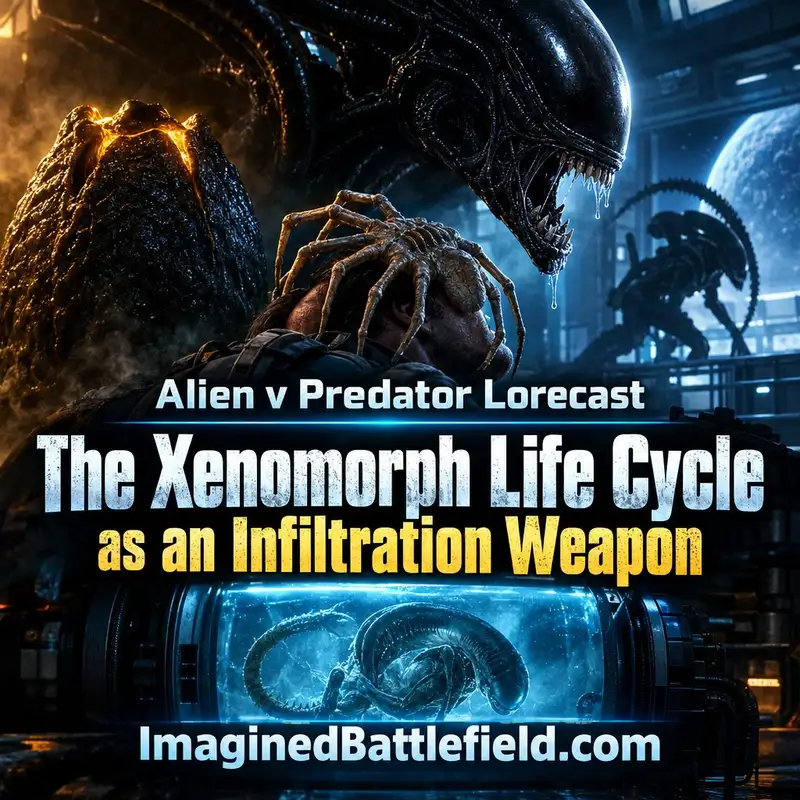
The Xenomorph Life Cycle as an Infiltration Weapon
The Xenomorph rarely enters a human system as an obvious battlefield threat. It arrives as something else first.
An egg becomes a discovery. A facehugger becomes a medical emergency. An implanted host becomes a patient who appears to recover. A transport becomes an evacuation route. A laboratory becomes a research opportunity. By the time an adult organism is visible, the most important security boundary may already have failed.
That is why the Xenomorph life cycle functions, in effect, like an infiltration weapon. That description does not require claiming that every organism was deliberately designed as a weapon, or that some known maker can aim, recall, or safely control it. The screen record does not establish those things. The point is operational. The life cycle repeatedly moves through ordinary human systems by exploiting what those systems are designed to do.
Curiosity brings people close. Salvage brings material aboard. Medicine protects the host. Infrastructure provides concealment. Evacuation carries survivors away. Research gives institutions a reason not to destroy what they have found.
The familiar sequence begins with a concealed biological source, often an egg. A facehugger emerges and attaches to a host. An embryo is implanted. The host may later appear to recover. Then a juvenile organism emerges, killing the host, and develops into an adult. In some incidents, that process expands into eggs, multiple hosts, reproductive spaces, and larger outbreaks.
Those stages matter because each defeats a different layer of defense. The egg challenges exploration, salvage, and access control. The facehugger challenges protective equipment and close-range response. The implanted host challenges quarantine, medicine, and command judgment. The chestburster turns a medical case into an internal security breach. The adult exploits the facility itself. Once multiple reproductive stages are present, the defenders may no longer know whether they are fighting one creature or an entire hidden population.
The screen stories do not provide one dependable clock for gestation, growth, or reproduction. Development rates differ. Environments differ. Unusual organisms and experiments differ. A serious containment approach therefore cannot depend on a neat universal timetable. It has to depend on observed exposure, conservative quarantine, and the assumption that a visible stage may not be the only stage present.
The Nostromo is the clearest small-scale example, and its most important lesson occurs before the adult organism appears. Kane is brought back from the derelict with a facehugger attached to him. Ripley tries to enforce quarantine. Dallas wants an injured crewmate treated. Ash overrides the barrier under a concealed recovery priority. The details matter, but the larger pattern is simple: the threat crosses the ship's boundary inside a person everyone has a moral reason to save.
The host is victim, transport, concealment, and leverage at the same time. That combination makes the life cycle especially dangerous to organizations built around ordinary rescue. Human systems are designed to help an injured person before treating that person as a possible route of biological entry. The facehugger exploits that instinct without needing to understand it. Once Kane is aboard, the ship's medical system becomes part of the reproductive process. When the visible parasite detaches and Kane appears to recover, the crew receives exactly the kind of reassurance that makes further isolation harder to sustain.
The chestburster proves that the crisis was already inside the ship. From that point onward, the Nostromo's architecture works against its crew. Shafts, machinery, access passages, and industrial compartments give the adult organism places to move and hide. Weapons are constrained because the ship is also life support. Corrosive blood makes a successful attack potentially dangerous to the hull and systems around it. The crew can fight individual moments, but it has already lost the clean separation between threat and habitat.
Aliens expands the same problem from one commercial ship to an entire colony. Hadley's Hope is not a fortress built for biological warfare. It is a working settlement with families, labor, medical care, vehicles, communications, industrial systems, and an atmosphere processor that makes life possible. That infrastructure is essential to the colonists before it becomes terrain for the outbreak.
The broad sequence is enough to understand the operational failure. Colonists investigate the derelict site. Exposure follows. Contact with the settlement is lost. By the time relief arrives, the threat has moved beyond one injured host or one adult creature. There are multiple organisms, facehuggers, cocooned colonists, and a developed reproductive environment inside the colony's own industrial spaces.
At that scale, reproduction changes the problem completely. A visible adult can still be shot, trapped, or driven away. But defenders must also ask what remains unseen. Eggs may be protected elsewhere. Facehuggers may still be active. Hosts may still be alive. Adults may be moving through parts of the complex nobody has searched. A queen is present in Hadley's Hope's mature reproductive environment, but that does not give the defenders a simple command chart or a guaranteed count of every organism in the colony.
The colony itself becomes part of the Xenomorph system. Corridors channel movement. Service routes conceal it. Machinery restricts fields of fire. Power failures reduce visibility. Medical spaces become uncertain. Landing zones and vehicles become the only way out. The atmosphere processor creates another severe constraint because heavy weapons or uncontrolled damage near critical systems can turn a biological outbreak into an industrial catastrophe.
The Colonial Marines arrive with far more firepower and training than the Nostromo crew ever possessed. That does not make them useless. Their weapons work. Their discipline matters. Their mobility and communications matter. The problem is that those advantages are introduced into a situation they do not yet understand.
They do not know the number of organisms. They do not know the condition of the colonists. They do not know the full extent of the reproductive site. They do not begin with a shared mission picture either. Lieutenant Gorman has formal command. Ripley brings the most relevant experience. Burke carries a concealed corporate recovery interest. Bishop has capabilities of his own. The Marines themselves have to make rapid tactical decisions when the plan begins failing.
Their first major engagement occurs in a confined reproductive environment near critical infrastructure. Weapons restrictions reduce the force they can bring to bear. Motion trackers provide warning but not a complete picture of elevation, route, numbers, or intention. The organisms use vertical and concealed spaces that the Marines cannot dominate simply by facing down a corridor with rifles ready.
Then mobility, communications, command, and extraction begin to fail together. That is what turns a bad firefight into an operational collapse. A force can still possess ammunition and lose the ability to evacuate casualties, move to defensible terrain, or coordinate what remains. Hadley's Hope demonstrates that firepower matters enormously, but firepower alone cannot rebuild a mission after information and mobility disappear.
Burke's hidden recovery objective adds the same distortion seen aboard the Nostromo. He is not proof that every corporate employee shares one perfect plan across decades. He is one representative pursuing biological value inside a rescue mission. That is enough. The moment a specimen becomes more valuable than transparent quarantine, survivors can be reclassified from people who need protection into possible carriers of something worth owning.
The colony also exposes the moral cost of containment by destruction. Once a mature outbreak occupies vital infrastructure and the scale of infection is unknown, destroying the site can appear tactically rational. But a colony is not empty terrain. It is a community that was already failed before the final denial decision became necessary. The last drastic measure cannot erase the earlier choices that left civilians trapped inside the problem.
Alien Three adds another layer: escape is not proof of containment. In the theatrical version, the surviving threat reaches Fiorina Fury One Six One, where a dog becomes the host for a new creature. The film does not provide a complete logistical explanation of every step in that transfer, and one is not required to see the risk. An escape craft that carries survivors away from one outbreak can also become the vehicle that starts the next.
Evacuation is therefore another security boundary. That does not mean people should be abandoned. It means the evacuation process has to account for a threat that may travel inside a host or vehicle without announcing itself. Survivors need screening, observation, quarantine authority, and someone empowered to delay movement when the biological picture is uncertain. The more desperate the escape, the harder those controls become to maintain.
Fiorina Fury One Six One is especially vulnerable because it is already an isolated industrial prison. Its population lacks the resources of a trained containment force. Medical options are limited. Authority is fragile. Industrial spaces create hiding places and chokepoints. The people confronting the organism have to convert whatever the facility already contains into a survival plan.
Alien Resurrection moves the problem in the opposite direction. There, the United Systems Military program aboard the Auriga is not trying to escape an accidental outbreak. It is deliberately trying to create and exploit one.
Its scientists clone Ripley, recover an alien queen through that process, breed organisms, and use captive human hosts. This is weaponization by institution rather than accidental carriage by workers. The program has laboratories, custody, expertise, and intent. It still cannot produce reliable control.
That failure reveals what weaponization actually requires. Discovery is only the first step. Then come custody, study, containment, reproduction, transport, deployment, target discrimination, recall, and political control. The Auriga can solve some early steps. It can obtain material, hold organisms for a time, and create new specimens. It cannot establish a dependable command relationship with them.
Possession is not obedience. The program also demonstrates why unusual forms must not be folded into one generic Xenomorph template. Ripley's clone, the queen associated with that experiment, the laboratory-grown organisms, and the Newborn arise from a specific program. They matter because they show what deliberate experimentation can produce, not because they define a universal field life cycle.
The same caution becomes even more important in Prometheus and Alien: Covenant. Prometheus presents the Engineer pathogen as a mutagenic and unstable biological hazard. Its behavior is not simply the standard egg, facehugger, chestburster sequence in liquid form. It creates a different kind of containment problem because exposure routes and effects are less predictable.
That changes the defenses that matter. A facehugger challenges close-contact protection and host quarantine. A pathogen challenges environmental controls, decontamination, medical surveillance, and perhaps air or fluid exposure depending on the event. Treating every extraterrestrial biological threat as one familiar organism can be as dangerous as treating them as unrelated curiosities.
Alien: Covenant reinforces the distinction. Airborne spores, neomorphs, David's experiments, eggs, and organisms associated with the mission form a particular chain of events. The presence of spores does not establish that every Xenomorph begins that way. The existence of one experimental pathway does not resolve every later or earlier organism into the same origin story.
David's work demonstrates extensive experimentation and a specific developmental chain. His claims should still be handled carefully. He is a manipulative synthetic with strong reasons to present himself as an author of life and death. The operational lesson does not depend on accepting every implication of his self-description. An experimenter who believes he understands a biological system can become one of its greatest hazards when the system remains only partly understood.
Alien: Romulus returns to corporate custody and failed research infrastructure. The young people entering the Romulus and Remus station are not a professional containment team. Their choices are shaped by Jackson's Star, by labor conditions, debt, restricted prospects, and the desire to escape. They enter abandoned corporate infrastructure without knowing the full biological history preserved inside it.
The station contains research tied to recovered organisms, facehuggers, adult Xenomorphs, and pathogen-derived experimentation. The danger is not simply that something remained alive. It is that dangerous material was preserved in a facility that later became accessible to people who had no reason to understand what its locked rooms were protecting.
Once an organism becomes proprietary research, destruction becomes institutionally difficult. A specimen can represent years of work, strategic advantage, or the solution to another problem. Managers may see value where a frightened person sees only a threat. Scientists may want one more observation. A corporation may want one more sample. Every delay gives the biological system another chance to use the facility around it.
The Offspring in Alien: Romulus must remain distinct from the ordinary reproductive model. It is connected to pathogen-derived experimentation and the film's particular laboratory history. The same caution applies to the Newborn, the Deacon, neomorphs, clones, and other unusual forms. Similarity can guide questions. It cannot replace observation.
Released episodes of Alien: Earth place related problems in the year twenty-one twenty under a different corporate order. A spacecraft crash, a facehugger attack, an alien containment breach, and an egg-related encounter show that the same security problem persists even when the political setting changes. The series does not need to provide a seamless explanation of every later film for that point to matter.
Recovery remains dangerous before an adult creature ever begins to hunt. Across these incidents, the life cycle attacks institutions in sequence. Perimeter security fails when the threat is classified as a discovery, patient, or sample. Medical security fails when urgency is mistaken for proof of safety. Command security fails when people with different priorities conceal information from one another. Facility security fails when the adult uses infrastructure more effectively than the defenders. Evacuation security fails when an escaping person or vehicle is assumed to be clean merely because it has left the first site.
A credible counter-infiltration response would therefore begin before anyone sees an adult Xenomorph. Unknown biological material should be investigated remotely whenever possible. Salvage has to be controlled. A recovered object needs physical separation from the people examining it. An airlock must be part of an actual isolation system, not simply a door between outside and inside. Medical quarantine needs independent authority, because the moment a patient appears recoverable is exactly when emotional pressure to break procedure becomes strongest.
Compassion and quarantine are not opposites. An exposed person needs care, observation, information, and dignity. The people around that person also need protection from a process neither side may yet understand.
Once an emergence occurs, the mission must change immediately. Medicine becomes internal security and damage control. Communications have to remain reliable. Command succession matters. Medical spaces, maintenance routes, and emergency craft have to be treated as possible pathways. Sensors should be understood as warning tools, not omniscient maps. Searches have to account for vertical movement, concealed spaces, and the risk that killing the organism may create acid damage or another environmental hazard.
If reproductive stages are present, the problem expands again. Eggs, facehuggers, hosts, and adults may occupy different parts of the same facility. Evacuation routes become potential dissemination routes. A team that kills an adult in one room may still have failed if an implanted survivor leaves the site or if eggs remain elsewhere.
This is why tactical success can coexist with containment failure. Humans can kill individual Xenomorphs. They can trap them, burn them, expel them into space, or destroy the places where they have established themselves. Those actions save lives. They matter.
What repeatedly fails is the assumption that the visible creature is the whole problem. By the time an adult Xenomorph appears in a corridor, a human system has often already carried it through several layers of protection. Someone investigated. Someone rescued. Someone admitted a patient. Someone preserved a specimen. Someone tried to move survivors. The organism's greatest advantage is not that humans lack weapons.
It is that human institutions often help it cross the boundary before they realize there is a war on the other side.